Category: Technology News

  • Goodbye Google Chrome? Zoho Launches Ulaa Browser as India’s Better Alternative

    Goodbye Google Chrome? Zoho Launches Ulaa Browser as India’s Better Alternative

    Ulaa Browser : In May 2023, Zoho Corporation, the Chennai-based tech giant, launched Ulaa, a privacy-first, Chromium-based web browser that’s been hailed as a “Made in India” alternative to Google Chrome. After winning India’s Indigenous Browser Development Challenge (IWBDC) and rolling out Ulaa Enterprise in May 2025, Ulaa has sparked buzz as a potential “Chrome killer.” Social media platforms are abuzz with users praising its speed and privacy features, but does it truly outshine Chrome? Let’s compare the two across privacy, performance, usability, and more to find out.

    What is Ulaa?

    Ulaa is a free browser available on Windows, macOS, Linux, Android, and iOS, developed by Zoho, the company behind tools like Zoho CRM and Mail. It emphasizes user privacy, blocks trackers and ads by default, and integrates tightly with Zoho’s ecosystem. The Enterprise edition, launched in 2025, adds advanced security controls and AI features powered by Zoho’s Zia assistant, appealing to businesses and privacy-focused users.

    So, how does Ulaa stack up against Google Chrome, which holds a dominant 65% global market share? Let’s break it down.

    Ulaa Browser
    Ulaa Browser

    Privacy: Ulaa’s Strongest Suit

    Ulaa is built for users who value privacy, setting it apart from Chrome’s data-heavy approach:

    • Tracker and Ad Blocking: Ulaa automatically blocks trackers, ads, and browser fingerprinting, minimizing your online footprint.
    • DuckDuckGo Default: It uses the privacy-centric DuckDuckGo as its default search engine, avoiding Google’s ecosystem.
    • Browser ID Reset: Each session starts with a fresh browser ID, making cross-site tracking difficult.
    • End-to-End Encryption: Sync data (bookmarks, passwords, etc.) is fully encrypted, and Zoho claims it collects no telemetry data.
    • Motion Sensor Blocking: Ulaa disables access to device motion sensors, a lesser-known tracking vector.

    Chrome, by contrast, relies on Google’s data collection for targeted advertising. To achieve similar privacy protections, you’d need extensions like uBlock Origin or Privacy Badger. For privacy-conscious users, Ulaa is the clear winner.

    Performance: Chrome Holds the Edge

    Speed and resource efficiency are critical for a smooth browsing experience. Here’s how they compare:

    • Ulaa: User reviews praise its quick startup and smooth performance for light to moderate use. However, it consumes more CPU and RAM than Chrome, especially with multiple tabs (e.g., 500MB+ idle with 10 tabs, spawning more processes). Its memory saver mode helps but isn’t as refined as Chrome’s.
    • Chrome: Known for its optimization, Chrome handles heavy multitasking and complex web apps with ease, using tab hibernation to keep resource usage low.

    Recent benchmarks (as of September 2025) show Chrome outperforming Ulaa in JavaScript execution and page load times, especially on demanding sites like video editors or gaming platforms. If speed is your priority, Chrome remains the leader.

    Ease of Use: Familiarity vs. Features

    Both browsers are user-friendly but cater to different audiences:

    • Ulaa (9.1/10 on user reviews): Its clean interface, customizable dashboards (minimal or smart with tracker stats), and browsing modes (Work, Personal, Kids) are popular. However, non-Zoho users may face a slight learning curve, and some report occasional login issues with Zoho IDs.
    • Chrome (9.6/10 on user reviews): Chrome’s minimalist design and universal familiarity make it effortless to use. Its integration with Google services like Gmail and Drive is a plus for many.

    Chrome wins for simplicity, but Ulaa’s unique features—like isolated modes and Zoho app integration—make it a productivity gem once mastered.
    Ulaa Browser
    Ulaa Browser

    Extensions and Ecosystem: Chrome’s Strength

    Extensions are a browser’s lifeblood, and both being Chromium-based helps with compatibility:

    • Ulaa: Supports most Chrome Web Store extensions, but its native library is smaller. Built-in tools like an ad blocker and password manager reduce the need for some add-ons, but power users may find the options limited.
    • Chrome: With a vast extension library and near-universal compatibility, Chrome is the go-to for customization.

    If you rely on niche extensions or developer tools, Chrome’s ecosystem is unmatched. Ulaa Browser is improving but still lags behind.

    Security: A Tight Race

    Security is a priority for both browsers, with different strengths:

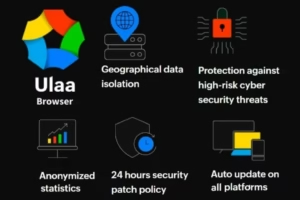
    • Ulaa: Features auto-updates, browser ID rotation, and robust privacy controls. The Enterprise edition offers IT admin tools like policy enforcement and data loss prevention, ideal for businesses.
    • Chrome: Google’s frequent patches and Safe Browsing protect against phishing and malware, but its open extension ecosystem can introduce risks if you install unverified add-ons.

    For individuals, it’s a tie—Ulaa’s privacy focus balances Chrome’s patching prowess. Businesses may lean toward Ulaa Browser Enterprise for its advanced controls.

    Battery and Memory: Chrome’s Efficiency

    Battery life is key, especially for mobile and laptop users:

    • Ulaa: Performs decently on mobile, but user feedback notes higher battery drain than Chrome, particularly during video streaming or heavy tab usage.
    • Chrome: Its tab hibernation and optimized rendering make it more power-efficient for prolonged use.

    For low-spec devices or extended sessions, Chrome is the better choice.
    Ulaa Browser
    Ulaa Browser

    Integration: Ecosystem Matters

    Your preferred apps can sway your choice:

    • Ulaa: A boon for Zoho users, offering one-click SSO login to Zoho apps (CRM, Mail, etc.) and Zia AI for searching across Zoho data. It’s less compelling outside the Zoho ecosystem.
    • Chrome: Ideal for Google Workspace users, with seamless access to Gmail, Drive, and Meet.

    Zoho users will love Ulaa’s integration; Google loyalists will stick with Chrome.

    What Users Are Saying

    As of September 30, 2025, social media and reviews reflect strong opinions:

    • Ulaa Fans: Users praise its “fast, ad-free browsing” and privacy focus, with many in India switching for “Swadeshi” pride. It earns 4.5/5 on app stores for its sleek UI and speed.
    • Critics: Some complain about crashes or high RAM usage (“Ulaa eats resources”). A few mention Zoho ID login bugs, though Zoho’s support is responsive.
    • Chrome’s Grip: Chrome’s reliability and speed keep it dominant for most users.

    The Verdict: Is Ulaa Better Than Chrome?

    Ulaa Browser is a bold Indian innovation, excelling in privacy and Zoho integration. It’s ideal if you:

    • Want to escape Google’s tracking and prioritize privacy.
    • Use Zoho apps and value a tailored browsing experience.
    • Support India’s push for homegrown tech.

    Also Read This : ICC Men’s T20 world cup 2026 : A Preview of Cricket’s Biggest Showdown

    Chrome, however, leads in:

    • Performance and battery efficiency.
    • Extension variety and compatibility.
    • Google ecosystem integration.

    Final Take: Ulaa Browser isn’t a Chrome killer yet, but it’s a strong contender for privacy hawks and Zoho users. If you need speed, extensions, or Google’s ecosystem, Chrome—or alternatives like Brave—may still be your go-to.


  • AI Pragya : UP advances in AI, emerging as a tech model in education, security, and agriculture

    AI Pragya : UP advances in AI, emerging as a tech model in education, security, and agriculture

    ‘AI Pragya’ initiative empowering youth, farmers, teachers, and govt staff with new tech skills

    AI driving innovations from women’s safety to smart farming and justice systems in UP

    Lucknow to become India’s first AI City with Rs 10,732 crore AI ecosystem development

    Over 10 lakh people being trained in AI with support from Microsoft, Google, and Intel

    Uttar Pradesh is no longer just the most populous state of India, it is fast emerging as a leader in shaping the country’s future through Artificial Intelligence (AI). Under the leadership of Chief Minister Yogi Adityanath, the state government has integrated AI into governance, education, agriculture, security, and healthcare, creating new benchmarks in public welfare.

    Widespread participation of Artificial Intelligence in health, research and education
    AI Pragya : Widespread participation of Artificial Intelligence in health, research and education

    A permanent framework for AI is being prepared at the policy level

    From initiatives like ‘AI Pragya’ to ‘UP Agris’, collaborations with IBM and Chandigarh University, and plans to develop Lucknow as an AI City, Uttar Pradesh is building a robust digital economy focused on transparency, productivity, and efficiency in citizen services. Aligning with the Government of India’s Vision 2047, the state’s AI policy and skill development programs highlight that UP is not just a consumer of technology but an emerging hub of innovation.

    AI Revolution in Uttar Pradesh: Shaping a Future-Ready State

    Artificial Intelligence is fast becoming the backbone of governance and development in Uttar Pradesh. By integrating AI into youth-centric policies, agriculture, education, and public services, the state is fostering a future-ready, tech-savvy population. With a clear vision, UP is positioning itself as a national and global leader in technology-driven growth.

    The state government is working on a draft AI policy in line with Vision 2047. Through AI bootcamps, officials from 30 departments have been trained to use AI effectively in government processes. To make the Direct Benefit Transfer (DBT) system more accurate and transparent, AI-based fraud detection and data analytics have also been introduced in some areas.

    A permanent framework for AI is being prepared at the policy level
    AI Pragya : A permanent framework for AI is being prepared at the policy level

    Lucknow moves towards becoming the country’s first AI city

    Under the IndiaAI Mission approved in March 2024, a massive AI ecosystem worth Rs 10,732 crore is being developed in Lucknow. It will include 10,000 GPUs, multi-modal language models, and an AI innovation center. This investment is 67% higher than any other technology infrastructure in the country. Additionally, an AI-based traffic management system is being proposed for Lucknow, while Varanasi is already in the process of implementing an AI-enabled smart traffic system.

    AI Pragya Yojana: Foundation stone of digital efficiency

    Under UP’s flagship initiative AI Pragya, more than 10 lakh youths, teachers, gram pradhans, government employees, and farmers are being trained in AI, machine learning, data analytics, and cybersecurity in partnership with tech giants like Microsoft, Intel, Google, and Guvi. The goal is to train 1.5 lakh people every month, with industry-ready certifications included in the program.

    New role of Artificial Intelligence in women safety and law and order

    In 17 municipal corporations and Gautam Buddh Nagar, AI-powered systems such as CCTV surveillance, facial recognition, number plate tracking, and SOS alert systems have been implemented. These are directly integrated with the 112 helpline and police control rooms. Additionally, in 70 prisons, the ‘Jarvis’ AI monitoring system is active, ensuring 24×7 surveillance of inmate activities.

    New role of Artificial Intelligence in women safety and law and order
    AI Pragya : New role of Artificial Intelligence in women safety and law and order

    Agriculture system is getting empowered with AI

    Under the UP Agris Project, launched with World Bank support and an investment of Rs 4,000 crore, 10 lakh farmers are being connected to AI-based technologies such as smart irrigation, drone mapping, pest detection, and digital market access. The initiative also involves 10,000 women’s self-help groups as active partners.

    AI Boosts Land and Mining Reforms in UP

    In the Revenue Department, satellite imaging and AI algorithms are being used for land consolidation and record management. This has enabled accurate digital mapping, transparent land distribution, and reduction of disputes. To protect mineral resources, 57 unmanned AI/IoT-enabled check gates have been set up across 25 districts. Illegal mining is being monitored using RFID tags, geofencing, and AI camera-equipped weighbridges.

    Agriculture system is getting empowered with AI
    AI Pragya : Agriculture system is getting empowered with AI

    Also Read This : What is the NISAR Mission? Know its Features, Launch Date, Objectives, and Technical Specifications

    AI Driving Healthcare and Education in UP

    In healthcare, the country’s first AI-based breast cancer screening center has been established in Fatehpur. Additionally, under an MoU between AKTU and IBM, free AI and cloud computing courses have been launched in 500 colleges. AI and machine learning are also being increasingly used in pharmaceutical research and health data analytics. An AI-driven question bank has been introduced to ensure fair and transparent police recruitment examinations.

  • AtCoder World Tour Finals 2025 : Humanity Triumphs Over AI

    AtCoder World Tour Finals 2025 : Humanity Triumphs Over AI

    AtCoder World Tour Finals 2025

    On July 20, 2025, the coding world witnessed an electrifying showdown at the AtCoder World Tour Finals 2025 in Tokyo, Japan. In a historic “Humans vs AI” heuristic competition, Polish programmer Przemysław Dębiak (Psyho) emerged victorious, defeating OpenAI’s custom AI model in a grueling 10-hour coding marathon. This blog dives into the details of this remarkable event, highlighting the triumph of human ingenuity over artificial intelligence.

    AtCoder World Tour Finals 2025
    AtCoder World Tour Finals 2025

    The Battle: Humans vs AI

    The AtCoder World Tour Finals 2025 was no ordinary programming contest. Designed to test the limits of both human and machine intelligence, the competition focused on NP-hard optimization problems—complex challenges that demand not just technical prowess but also creative problem-solving. The stage was set for a thrilling clash between Przemysław Dębiak, a former OpenAI employee and seasoned competitive programmer, and OpenAI’s state-of-the-art AI model, tailored for high-performance coding.

    The contest spanned 10 intense hours, pushing participants to their limits. Dębiak, operating on minimal sleep, showcased the resilience and adaptability that define human competitors. His opponent, OpenAI’s AI, brought unparalleled computational speed and precision to the table, making this a true test of human intuition versus machine efficiency.

    AtCoder World Tour Finals 2025
    AtCoder World Tour Finals 2025

    The Result: A Human Victory

    When the final scores were tallied, Dębiak clinched the championship with an impressive 1.81 trillion points, outperforming OpenAI’s AI by a significant 9.5% margin (1.65 trillion points). This victory was not just a personal triumph for Dębiak but a moment of pride for the global programming community. As he celebrated his win, Dębiak took to X, posting, “Humanity has prevailed (for now!)”—a nod to the ongoing rivalry between human coders and AI systems.

    Why This Matters

    The AtCoder World Tour Finals 2025 highlighted the unique strengths of human programmers. While AI excels at rapid computation and pattern recognition, Dębiak’s success underscored the power of human intuition, creativity, and strategic thinking. NP-hard problems often require unconventional approaches, and Dębiak’s ability to think outside the box gave him the edge over the AI’s algorithmic precision.

    This event also sparked discussions about the future of competitive programming. As AI continues to advance, contests like these serve as a benchmark for measuring human capabilities against machine intelligence. Dębiak’s victory is a reminder that, for now, humans can still hold their own in domains that demand both technical skill and creative insight.

    AtCoder World Tour Finals 2025
    AtCoder World Tour Finals 2025

    The Bigger Picture

    The “Humans vs AI” narrative at AtCoder 2025 resonates beyond the coding arena. It reflects the broader dialogue about the role of AI in our world. While AI tools like OpenAI’s model are transforming industries, human ingenuity remains a critical force in solving complex, open-ended problems. Dębiak’s win is a testament to the enduring value of human expertise, even in an age of rapid technological progress.

    Also Read This : Astronomer CEO Controversy: Coldplay Concert Sparks Speculation

    The AtCoder World Tour Finals 2025 will be remembered as a landmark event in competitive programming. Przemysław Dębiak’s triumph over OpenAI’s AI model is a celebration of human potential, proving that creativity and perseverance can still outshine even the most advanced algorithms. As the coding community looks ahead, one thing is clear: the battle between humans and AI is far from over, and events like these will continue to shape the future of technology.

  • BitChat : The Future of Decentralized, Offline Messaging 2025

    BitChat : The Future of Decentralized, Offline Messaging 2025

    BitChat : In a world increasingly reliant on internet connectivity and centralized platforms, privacy and accessibility in communication are under constant scrutiny. Enter BitChat, a revolutionary decentralized messaging app launched in July 2025 by Jack Dorsey, co-founder of Twitter and CEO of Block. Designed to operate without internet, servers, or personal identifiers, BitChat leverages Bluetooth Low Energy (BLE) mesh networking to deliver secure, private, and censorship-resistant communication. This blog dives into what makes BitChat unique, its technical underpinnings, use cases, limitations, and why it’s generating buzz in the tech world.

    BitChat
    BitChat

    What is BitChat?

    BitChat is a peer-to-peer messaging application that allows users to communicate without relying on traditional internet infrastructure. Unlike mainstream apps like WhatsApp or Signal, which depend on centralized servers and internet access, BitChat uses a Bluetooth mesh network to relay messages directly between devices. This makes it ideal for scenarios where connectivity is limited or undesirable, such as during natural disasters, protests, or in remote areas.

    Key Features

    1. Offline Communication via Bluetooth Mesh:
      • BitChat operates over Bluetooth Low Energy (BLE), enabling devices to communicate within a 300-meter range.
      • Messages hop across nearby devices in a mesh network, extending the communication range without internet access.
      • No need for Wi-Fi, cellular data, or servers—perfect for off-grid scenarios.
    2. End-to-End Encryption:
      • All messages are encrypted, ensuring only the sender and intended recipient can read them.
      • No data is stored on central servers, reducing risks of surveillance or data breaches.
    3. No Personal Identifiers:
      • Users don’t need phone numbers, email addresses, or accounts to use BitChat.
      • Anonymity is enhanced through cryptographic keys, making it ideal for privacy-conscious users.
    4. Store-and-Forward Messaging:
      • Messages are cached on intermediary devices for offline recipients.
      • Regular peers store messages for 12 hours, while “favorite” contacts store them indefinitely until delivery.
    5. Group Chats and Channels:
      • Users can create public or private “rooms” using hashtags (e.g., #FestivalChat).
      • Rooms support password protection and ownership transfer for flexible group communication.
    6. Open-Source and Transparent:
      • BitChat’s code and whitepaper are publicly available on GitHub (permissionless tech/bitchat and bitchat-android).
      • The open-source nature invites community scrutiny and contributions, ensuring trust and security.
    7. Future Enhancements:
      • Planned support for Wi-Fi Direct to improve range and speed.
      • Ongoing development to refine user experience and expand platform compatibility.
    BitChat operates over Bluetooth Low Energy (BLE)
    BitChat operates over Bluetooth Low Energy (BLE)

    How BitChat Works

    BitChat’s core innovation lies in its use of Bluetooth Low Energy (BLE) mesh networking. Here’s a simplified breakdown of its functionality:

    1. Device Discovery:
      • Devices running BitChat detect nearby peers via Bluetooth, forming an ad-hoc network.
      • No central server coordinates the network; devices self-organize to relay messages.
    2. Message Routing:
      • Messages are sent to a specific recipient or group via cryptographic addressing.
      • If the recipient is out of range, intermediary devices forward the message until it reaches its destination.
    3. Encryption and Security:
      • Messages are end-to-end encrypted using modern cryptographic protocols.
      • The absence of centralized storage ensures no third party, including BitChat’s developers, can access user data.
    4. Store-and-Forward:
      • If a recipient is offline, nearby devices temporarily store the message.
      • This feature ensures reliable delivery even in dynamic environments like festivals or protests.

    Why BitChat Matters

    BitChat addresses critical gaps in modern communication systems. Here are some key use cases:

    1. Disaster Response

    During natural disasters like hurricanes or earthquakes, internet and cellular networks often fail. BitChat allows affected communities to coordinate relief efforts, share updates, or request help without relying on infrastructure.

    2. Protests and Activism

    In regions where governments monitor or shut down internet access during protests, BitChat provides a secure, censorship-resistant way to organize and communicate. Its anonymity features protect activists from surveillance.

    During natural disasters like hurricanes or earthquakes, internet and cellular networks often fail.
    During natural disasters like hurricanes or earthquakes, internet and cellular networks often fail.

    3. Remote and Rural Areas

    In areas with poor connectivity, such as rural regions or developing countries, BitChat enables communication without expensive infrastructure or data plans.

    4. Festivals and Events

    At crowded events like music festivals, where cell networks are often overloaded, BitChat lets attendees stay connected with friends or join event-specific group chats.

    5. Privacy Advocacy

    For users concerned about data privacy, BitChat’s decentralized, serverless design eliminates reliance on Big Tech platforms that may collect or monetize user data.

    Current Status and Availability

    As of July 12, 2025, BitChat is in its beta phase, generating significant excitement on platforms like X. Here’s where things stand:

    • iOS/macOS: Available via TestFlight, though it quickly hit its 10,000-user limit. Users can also build the app from source using Xcode.
    • Android: A beta APK is available on GitHub, with a full release in development.
    • App Store Review: BitChat is under review for broader App Store distribution, which could expand its reach.
    • Community Feedback: X posts highlight enthusiasm for BitChat’s potential, with some users speculating about future integrations like Bitcoin transactions (though not currently supported natively).

    Limitations and Challenges

    While BitChat is promising, it’s not without challenges:

    1. Range Limitations:
      • Bluetooth’s 300-meter range restricts direct communication, though mesh networking mitigates this.
      • Dense environments with many users improve range, but sparse areas may limit connectivity.
    2. Beta-Phase Bugs:
      • As a beta product, BitChat may have stability issues or unpolished features.
      • Private message and channel encryption lacks external security audits, though the open-source code invites community review.
    3. Technical Setup:
      • Non-TestFlight users need technical know-how to build and install the app (e.g., via Xcode or APK).
      • This may limit accessibility for less tech-savvy users.
    4. Scalability:
      • Mesh networks can strain device resources in very large groups.
      • Future Wi-Fi Direct support aims to address this, but it’s not yet implemented.
    Non-TestFlight users need technical know-how to build and install the app
    Non-TestFlight users need technical know-how to build and install the app

    The Buzz on X and Beyond

    BitChat has sparked lively discussions on X, with users praising its potential to disrupt centralized messaging apps. Some notable sentiments include:

    • “BitChat is a game-changer for protests and festivals. No internet, no problem!” (@TechNomad2025)
    • “Jack Dorsey’s vision for decentralized tech is coming to life with BitChat. Privacy first!” (@CryptoPioneerX)
    • Speculation about Bitcoin integration, though the whitepaper focuses solely on messaging for now.

    The tech community is also excited about BitChat’s open-source nature, with developers contributing to its GitHub repositories and suggesting features like file sharing or voice messages.

    What’s Next for BitChat?

    BitChat’s roadmap includes several exciting developments:

    • Wi-Fi Direct Support: To enhance range and speed, making BitChat viable for larger networks.
    • Cross-Platform Expansion: Full Android and iOS releases to reach a broader audience.
    • Security Audits: External reviews to validate encryption and privacy claims.
    • Community Features: Enhanced group chat functionality and potential integrations for niche use cases.

    Why You Should Care

    BitChat represents a bold step toward a future where communication is truly decentralized, private, and resilient. Whether you’re an activist, a festival-goer, or simply someone who values privacy, BitChat offers a compelling alternative to traditional messaging apps. Its open-source ethos and innovative use of Bluetooth mesh networking make it a project worth watching.

    Cross-Platform Expansion
    Cross-Platform Expansion

    How to Get Started

    1. Join the Beta:
      • For iOS/macOS, check TestFlight or build from the GitHub repo (permissionless tech/bitchat).
      • For Android, download the APK from GitHub (bitchat-android).
    2. Explore the White Paper:
      • The official whitepaper on GitHub provides a deep dive into BitChat’s technical architecture.
    3. Join the Community:
      • Follow discussions on X using hashtags like #BitChat or #DecentralizedMessaging.
      • Contribute to the open-source project or share feedback with the developers.

    Also Read This : Why Scarlett Johansson Remains Hollywood’s Most Versatile Star in 2025

    BitChat is more than just a messaging app—it’s a vision for a decentralized, privacy-first future. By leveraging Bluetooth mesh networking, Jack Dorsey and his team have created a tool that empowers users to communicate freely, even in the most challenging environments. While still in beta, BitChat’s potential to reshape how we connect is undeniable. Whether you’re navigating a disaster zone, protesting for change, or just seeking a private way to chat, BitChat is worth exploring. Download it, test it, and join the decentralized revolution today.

  • Grok 4 Launched : xAI’s Most Advanced AI for Coding, Reasoning & More

    Grok 4 Launched : xAI’s Most Advanced AI for Coding, Reasoning & More

    Grok 4 Launched : We’re excited to launch Grok 4, our most advanced AI yet, designed to elevate reasoning, coding, and versatility. At xAI, we’re committed to accelerating human discovery, and Grok 4 is a major step toward that mission, empowering users with smarter, more intuitive tools.

    What’s New in Grok 4?

    Grok 4 builds on Grok 3’s foundation, delivering breakthrough performance. Here’s what’s in store:

    Grok 4 Launched
    Grok 4 Launched

    1. Superior Reasoning

    Grok 4’s first-principles reasoning tackles complex problems with unmatched clarity. From mathematical proofs to nuanced questions, it outperforms predecessors, matching top models on benchmarks like AIME and GPQA.

    2. Grok 4 Code: Built for Developers

    Grok 4 Code is here: your new go-to for powerful, efficient coding.

    • Real-time IDE integration: Works seamlessly in coding environments.
    • Advanced code generation: Writes, optimizes, and debugs across Python, C++, Rust, and more.
    • Context-aware solutions: Understands project goals for full-stack support. Grok 4 Code streamlines development, helping teams build faster and smarter.

    3. Multimodal Features (Coming Soon)

    Grok 4 excels in text now, with vision and image-generation capabilities arriving soon, expanding its multimodal potential.

    4. Enhanced Truth-Seeking

    Grok 4’s improved training foundation means fewer errors and more objective, reliable outputs. Its 130K token context window supports deep conversations and document analysis.

    5. Meme-Savvy Personality

    Grok 4 brings humor and cultural flair, decoding memes and engaging playfully while staying sharp and insightful.

    Grok 4 Launched
    Grok 4 Launched

    Accessing Grok 4

    Grok 4 is available now through:

    • xAI’s API: Partial endpoints live, with full rollout soon.
    • X Platform: Available exclusively to Premium Plus and SuperGrok members.
    • Mobile Apps: Free quotas on iOS and Android, with premium perks.

    Grok 4 Launched Livestream Recap

    Missed the July 9, 2025, 8:00 PM PT livestream? The replay showcases Grok 4’s capabilities and xAI’s vision for AI’s future.

    Also Read This : YouTube Partner Program 2025 : New Monetization Rules for Creators (July 15 Update)

    What’s Next?

    Expect more from Grok 4, including:

    • Multimodal upgrades: Vision and image generation.
    • Open-source models: Smaller variants for research.
    • Ongoing enhancements: Powered by our Colossus supercluster.

    We’re dedicated to addressing bias and security, ensuring Grok 4 remains trustworthy.

  • Meta AI in Defence : How Meta is Revolutionizing Military Tech with AR & AI

    Meta AI in Defence : How Meta is Revolutionizing Military Tech with AR & AI

    Meta AI in Defence, the tech giant behind globally recognized social media platforms like WhatsApp, Facebook, and Instagram, is reportedly venturing into uncharted territory: the defense industry. Known for its expertise in connecting billions of people through digital platforms, Meta is now poised to make waves in military technology by developing advanced, high-tech helmets and glasses for the U.S. military. This strategic pivot signals a significant shift in the company’s vision, blending its cutting-edge technological prowess with the rigorous demands of defense applications.

    Meta’s New Venture: High-Tech Military Gear

    According to recent reports, Meta is gearing up to design and manufacture specialized helmets and glasses equipped with state-of-the-art features for the U.S. armed forces. These are not ordinary pieces of equipment but are expected to integrate advanced technologies, potentially including augmented reality (AR), heads-up displays (HUDs), and enhanced communication systems. Such innovations could provide soldiers with real-time battlefield data, improved situational awareness, and seamless coordination during operations.

    Meta AI in Defence
    Meta AI in Defence

    The move aligns with Meta’s long-standing investment in AR and virtual reality (VR) technologies, as seen in products like the Oculus VR headsets and its broader metaverse ambitions. By leveraging its expertise in immersive tech, Meta aims to create military-grade equipment that could redefine how soldiers interact with their environment, making operations safer and more efficient.

    Why Defense? A Strategic Shift for Meta

    Meta’s entry into the defense sector may seem surprising, given its roots in social media, but it reflects a growing trend among tech giants exploring opportunities in defense contracts. Companies like Microsoft and Google have previously secured contracts to supply technology to military forces, from cloud computing to AI-driven solutions. For Meta, this move could diversify its portfolio, reduce reliance on ad-driven revenue, and position it as a key player in the lucrative defense market.

    Meta AI in Defence
    Meta AI in Defence

    The decision also comes at a time when Meta is facing scrutiny over privacy concerns and regulatory challenges in its core social media business. By pivoting to defense, Meta could tap into a new revenue stream while showcasing its ability to innovate in high-stakes, mission-critical environments.

    What to Expect from Meta’s High-Tech Helmets and Glasses

    While specific details about the helmets and glasses remain under wraps, industry experts speculate that Meta’s products will incorporate cutting-edge features, such as:

    • Augmented Reality (AR) Displays: Providing soldiers with real-time overlays of maps, enemy positions, and mission objectives.
    • Enhanced Communication Systems: Secure, encrypted channels for seamless coordination between units.
    • Night Vision and Thermal Imaging: Advanced optics for improved visibility in low-light or adverse conditions.
    • Biometric Monitoring: Sensors to track soldiers’ vitals, ensuring optimal performance and health during missions.
    • Lightweight, Durable Design: Built to withstand harsh environments while remaining comfortable for prolonged use.
    Meta AI in Defence
    Meta AI in Defence

    These features could give U.S. forces a technological edge, blending Meta’s consumer-tech expertise with the rugged requirements of military operations.

    Meta AI in Defence : Challenges and Opportunities

    Entering the defense industry is not without its challenges. Meta will need to navigate strict regulatory standards, rigorous testing protocols, and competition from established defense contractors like Lockheed Martin and Raytheon. Additionally, the company may face public and ethical scrutiny, as partnerships between tech giants and military organizations often spark debates about the militarization of technology.

    However, the opportunities are vast. A successful foray into defense could solidify Meta’s reputation as a versatile innovator, capable of delivering solutions beyond the consumer market. It could also open doors to further government contracts, both in the U.S. and globally, while driving advancements in AR and wearable technology that could eventually trickle down to consumer products.

    The Bigger Picture: Tech Giants in Defense

    Meta’s move is part of a broader trend where technology companies are increasingly collaborating with defense agencies. From Microsoft’s HoloLens for military training to Amazon’s cloud services for the Pentagon, the lines between consumer tech and defense applications are blurring. Meta’s expertise in AR, AI, and connectivity positions it uniquely to contribute to this evolving landscape, potentially reshaping how military technology is developed and deployed.

    Meta AI in Defence
    Meta AI in Defence

    Also Read This: ChatGPT Outage : What Happened and What’s Next?

    Meta’s reported entry into the defense industry marks a bold and ambitious step for the tech giant. By developing high-tech helmets and glasses for the U.S. military, Meta is not only diversifying its business but also pushing the boundaries of what’s possible with AR and wearable technology. As the company ventures into this new frontier, all eyes will be on how it balances innovation, ethics, and the demands of one of the world’s most critical industries. This could be the beginning of a transformative era for Meta, as it moves from connecting people online to empowering soldiers on the battlefield.

  • ChatGPT Outage : What Happened and What’s Next?

    ChatGPT Outage : What Happened and What’s Next?

    ChatGpt Outage : On June 10, 2025, ChatGPT, one of the most widely used AI chatbots, faced a significant global outage that left users across North America, Europe, India, and Australia unable to access the service. Starting around 2:36 AM ET, reports flooded in about network errors, unresponsive chats, and error messages, impacting both free and ChatGPT Plus users. This disruption also affected OpenAI’s Sora and GPT API services, highlighting the interconnected nature of their infrastructure.

    ChatGpt Outage
    ChatGpt Outage

    What Caused the ChatGpt Outage?

    According to OpenAI’s official status page, the issue stemmed from elevated error rates and latency, with the root cause identified but not publicly detailed. By 7:51 PM IST, OpenAI was still working on a fix, with no clear timeline for full restoration. DownDetector reported a peak of over 1,000 user complaints around 5:30 AM ET, with India alone logging over 800 reports by 3 PM IST. The widespread downtime raised concerns about the reliability of AI-driven services, especially for businesses and developers relying on the GPT API.

    User Reactions and Impact

    The outage sparked a wave of reactions on platforms like X, where users expressed frustration, some humorously noting their dependence on AI for daily tasks. Others speculated about potential updates or server overloads. For ChatGPT Plus subscribers, the disruption was particularly inconvenient, as premium services promise higher reliability and uptime. Developers using the GPT API reported stalled projects, while Sora users faced delays in generating AI-driven content.

    ChatGpt Outage
    ChatGpt Outage

    This incident underscores the growing reliance on AI tools and the ripple effects when technology fails. Businesses, students, and casual users alike were reminded of the importance of backup systems and diversified workflows.

    Also Read This: Vijay Shankar : The Resilient All-Rounder of Indian Cricket

    What’s Next for ChatGPT?

    OpenAI’s team is actively addressing the issue, and while no official ETA has been shared, past outages suggest a resolution within hours to a day. Users are advised to avoid repeatedly refreshing sessions to prevent triggering security verifications, which could further delay access. For real-time updates, check OpenAI’s status page or platforms like X for user-driven insights.

  • India’s Digital Address System : Revolutionizing Locations with DIGIPIN

    India’s Digital Address System : Revolutionizing Locations with DIGIPIN

    India’s Digital Address System

    India’s digital transformation is taking another leap forward with the government’s ambitious plan to assign a unique digital ID to every address in the country, akin to the Aadhaar system for individuals. This initiative, centered around the Digital Postal Index Number (DIGIPIN), aims to integrate physical addresses into India’s Digital Public Infrastructure (DPI), streamlining services like e-commerce, government delivery, and more. Following the success of Aadhaar for identity and UPI for payments, this digital address system promises to tackle longstanding issues with India’s address infrastructure. Let’s explore what this plan entails, why it matters, and how it could reshape daily life.

    What is the Digital Address System?

    The Indian government, led by the Department of Posts and supervised by the Prime Minister’s Office, is developing a Digital Address System to assign a unique 10-character alphanumeric code, known as DIGIPIN, to every home, shop, or building. Unlike traditional postal PIN codes that cover large areas, DIGIPIN uses precise GPS-based map coordinates to pinpoint exact locations. This system aims to address the challenges of India’s current address framework, where vague, incomplete, or landmark-based addresses often cause delays and errors in service delivery.

    What is the Digital Address System?
    What is the Digital Address System?

    The initiative is part of India’s broader Digital Public Infrastructure (DPI) vision, which already includes Aadhaar for identity verification and UPI for seamless payments. The government plans to release a draft policy for public feedback soon, with a potential law to establish a dedicated authority during the winter session of Parliament. Once rolled out, DIGIPIN could become as integral to daily life as Aadhaar or UPI.

    Why Now? The Need for a Digital Address System

    India’s current address system is riddled with inefficiencies. Many addresses are unclear, rely on landmarks (e.g., “near the old banyan tree”), or vary in format, making them hard to process digitally. This creates significant hurdles for:

    • E-commerce and Logistics: With the boom in online shopping, courier services, and food delivery apps, inaccurate addresses lead to delayed or failed deliveries. Government studies estimate that incomplete address information costs India’s economy $10-14 billion annually, roughly 0.5% of GDP.
    • Government Services: Inconsistent addresses complicate the delivery of subsidies, healthcare, and other public services, especially in rural or remote areas like villages, slums, forests, or hilly regions.
    • Data Privacy: Private companies often collect and share address data without clear consent, raising privacy concerns. The new system aims to ensure addresses are shared only with explicit user permission.

    The rise of digital services has made precise, standardized addresses more critical than ever. DIGIPIN addresses these issues by providing a unique, location-specific code that enhances accuracy and efficiency.

    Digital Address System
    Digital Address System

    How DIGIPIN Works

    DIGIPIN is a 10-character alphanumeric code tied to the exact geospatial coordinates of a location, such as a house, apartment, or business. Unlike traditional PIN codes, which cover broad areas, DIGIPIN offers pinpoint accuracy, making it ideal for:

    • Urban and Rural Areas: Each flat in an apartment complex or home in a remote village will have its own unique DIGIPIN, ensuring no ambiguity.
    • Challenging Terrains: Areas like slums, forests, or hilly regions, where formal addresses are often absent, will benefit from DIGIPIN’s GPS-based precision.
    • Digital Integration: DIGIPIN can be linked to services like eKYC, property tax records, or utility management, simplifying processes across sectors.

    For example, an address like “Flat 3B, Sunshine Apartments, Mumbai” could be replaced or supplemented by a DIGIPIN like “X7P4Q8R2T9,” which maps directly to the building’s entrance coordinates. This code can be shared via SMS, apps, or websites, making it easy to use in digital systems.

    Benefits of the Digital Address System

    The DIGIPIN system promises transformative benefits across various sectors:

    1. Enhanced Delivery Efficiency: E-commerce and logistics companies can deliver packages faster and more accurately, reducing costs and customer complaints.
    2. Improved Government Services: Precise addresses will streamline the delivery of subsidies, healthcare, and voting services, especially for marginalized communities in remote areas.
    3. Privacy Protection: By requiring explicit consent for address data sharing, the system aims to curb misuse by private entities, aligning with India’s focus on data security.
    4. Economic Impact: Reducing address-related inefficiencies could save billions annually, boosting productivity in e-commerce, governance, and more.
    5. Support for Digital India: As part of the DPI ecosystem, DIGIPIN complements Aadhaar and UPI, creating a robust framework for digital services.
    Benefits of the Digital Address System
    Benefits of the Digital Address System

    Challenges and Concerns

    While the initiative is promising, it’s not without challenges:

    • Privacy Risks: Critics, as seen in posts on X, worry that linking addresses to a centralized system could enable tracking or surveillance, similar to concerns raised about Aadhaar. The government must ensure robust safeguards to protect user data.
    • Implementation Hurdles: Mapping every address in India, especially in rural and informal settlements, is a massive undertaking. The success of pilot projects, like the earlier eLoc initiative, will be critical.
    • Public Adoption: Convincing citizens to adopt DIGIPIN and trust the system will require clear communication and user-friendly tools, similar to the mAadhaar app for Aadhaar services.
    • Regulatory Framework: The proposed authority must balance innovation with oversight to prevent misuse and ensure inclusivity, especially for those without digital access.

    The Road Ahead

    The government is moving swiftly, with a draft policy expected for public feedback within weeks and a full rollout targeted by year-end. A new law may establish a dedicated authority to oversee the system, ensuring accountability and standardization. Pilot projects, like the earlier Digital Address Code (DAC) and eLoc initiatives, suggest that the technology is feasible, with companies like MapmyIndia already claiming to have mapped over 20 million locations.

    As with Aadhaar, public trust will be key. The government’s emphasis on consent and privacy-first protocols is a step in the right direction, but addressing concerns about surveillance and ensuring accessibility for all—especially in remote areas—will determine the system’s success.

    Digital Address System
    Digital Address System

    Aadhaar for home

    India’s Digital Address System, powered by DIGIPIN, is poised to revolutionize how we locate and interact with places. By addressing the inefficiencies of traditional addresses, it promises to boost e-commerce, enhance government service delivery, and protect user privacy. As the initiative unfolds, it could become a cornerstone of India’s Digital Public Infrastructure, joining Aadhaar and UPI in transforming daily life. What are your thoughts on this digital leap? Share them in the comments, and stay tuned for updates as DIGIPIN rolls out nationwide!

    Also Read This : GTA 6 : Everything You Need to Know About the Most Anticipated Game of 2026

    Sources: Firstpost, India Today, Times Now, Economic Times, Sakshi Post

  • ChatGPT Shopping : Revolution or Rough Start?

    ChatGPT Shopping : Revolution or Rough Start?

    ChatGPT Shopping

    OpenAI’s latest venture into e-commerce has turned heads, with ChatGPT now doubling as a shopping assistant. Launched in late April 2025, this feature lets users search, compare, and buy products—from fashion to electronics—right within the chatbot. No ads, no browser hops, just a conversational nudge toward your next purchase. But is it a game-changer or a work in progress? Let’s unpack it.

    What’s New with ChatGPT Shopping?

    Imagine asking ChatGPT Shopping for a new air fryer and getting a curated list of options, complete with images, prices, and reviews, all neatly packed into visual product cards. That’s the promise. Powered by the GPT-4o model, the feature taps into third-party metadata to deliver results across categories like beauty, home goods, and tech. It’s available to everyone—free users, logged-out folks, and globe-trotters alike. OpenAI claims the recommendations are independent, driven purely by what you’re looking for, not by paid placements. Plus, you can ask follow-up questions to refine your choices, like picking a jacket that matches your vibe or budget.

    ChatGPT Shopping
    ChatGPT Shopping

    The Good: A Fresh Take on Shopping

    For some, it’s a breath of fresh air. One user raved about ChatGPT outshining traditional search engines, delivering detailed air fryer recommendations without a single click. The conversational flow feels natural—you ask, it answers, and suddenly you’re comparing models like a pro. No pop-up ads, no endless scrolling. The focus on intent-driven results means you’re not wading through sponsored listings or irrelevant suggestions (well, most of the time). For busy shoppers or those who hate tab overload, this streamlined approach could be a lifesaver.
    The Not-So-Good: Growing Pains

    Not everyone’s sold. Early feedback points to glitches, like users asking about niche topics—say, tariffs—and getting bizarrely off-topic results, like skincare products. Reddit’s buzzing with gripes about inconsistent recommendations, hinting that the AI’s still learning to nail context. Then there’s the privacy angle. If you’re a Plus or Pro user, ChatGPT Shopping might dip into your chat history for hyper-personalized picks. Sounds cool, but it’s got folks wondering how much of their data is fueling those suggestions. OpenAI’s tight-lipped on specifics, which doesn’t help.

    ChatGPT Shopping
    ChatGPT Shopping

    What’s Next?

    OpenAI’s playing the long game. They’re not making money from purchases or affiliate links yet, but they’ve left the door open for “tasteful” monetization down the road. Rumors of a Shopify partnership are swirling, which could tighten the e-commerce loop. With 500 million users and over a billion weekly searches, ChatGPT’s got the muscle to challenge giants like Google Shopping or Amazon—if it can iron out the kinks.

    Also Read This : Meet Ayush Mhatre : India’s Rising Cricket Sensation

    The Verdict

    ChatGPT’s shopping feature is bold, no question. It’s got the bones of something special: a chat-first, ad-free way to shop that feels like texting a savvy friend. But it’s not flawless. Missteps in relevance and murky data practices could trip it up if OpenAI doesn’t course-correct. For now, it’s a promising experiment—one worth trying if you’re curious, but don’t expect perfection just yet. Have you given it a spin? Let’s hear your take.