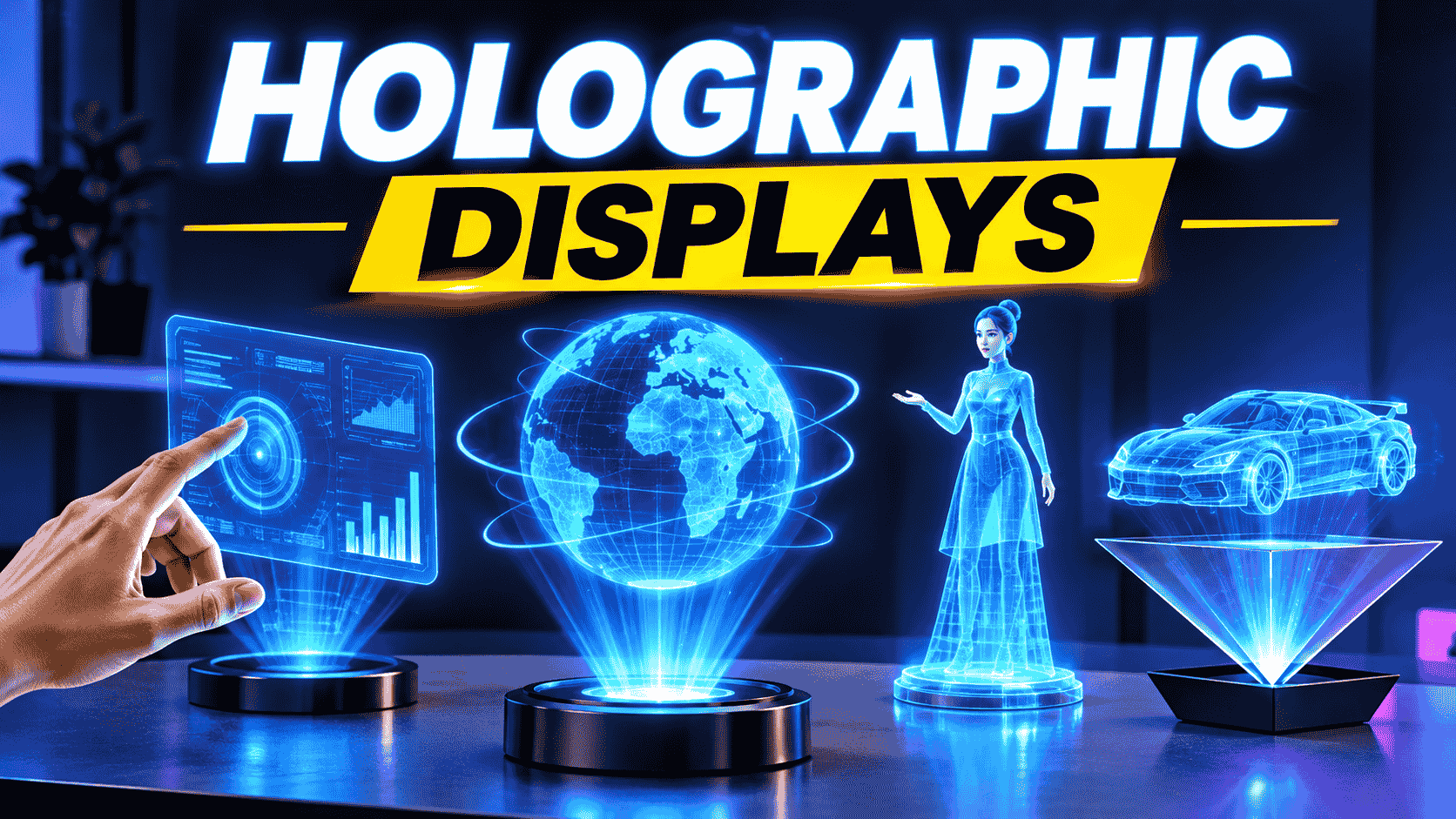
Holographic displays reconstruct 3D light wavefronts to create images with natural depth and parallax that can be viewed without glasses. True systems use diffraction (often via spatial light modulators and computer-generated holograms), while many commercial “holographic” products rely on LED fans, transparent LCDs, or light-field tricks for a similar floating effect. As of 2026 they appear in specialized tables, automotive windshield prototypes (like Mercedes’ Holo Display), retail signage, and research AR devices, though full dynamic, high-resolution, wide-angle consumer versions remain limited by computation, brightness, and viewing angle challenges.
Holographic Displays: The Future of 3D Vision Without Headsets
Why holograms are better than normal screens, and how a new invention is solving their biggest problems
1. Real Depth, Not Fake Depth
Holographic images have real depth because they are truly three-dimensional. Monitors only _pretend_ to show depth on a flat 2D screen. With holograms, you can watch a 3D image that blends perfectly into your normal view of the real world.
2. A Truly Immersive Experience
The result is a Virtual and Augmented Reality display that is truly immersive. You can move your head normally and you will never lose the holographic image from your view. To get the same feeling from a monitor, you would have to sit right in front of a cinema screen.
And the best part? You don’t need to wear a heavy screen in front of your eyes.
3. No More Bulky Headsets – Just Normal Glasses
The optical elements needed to create these holograms are very small and can easily fit on a normal pair of glasses. Today’s VR headsets need a full headset because they have to fit a screen and hardware inside it.
Holographic glasses could change how we connect with everything – from getting routes while driving, to checking a patient during surgery, to getting repair information for basic work at home.
4. The Biggest Challenge: Size vs. Clarity
One of the biggest challenges is quality. Holographic images are made by small chip-like tools called Spatial Light Modulators (SLM). Till now, these modulators had a big problem – they could make images that were either small and clear, or large and blurry. This trade-off between image size and clarity was a major issue. If you looked towards the corner of the display, the full image could disappear.
5. The New Solution: A Second Optical Element
To solve this, researchers created a second optical element to work together with the Spatial Light Modulator. This device takes the light from the SLM and increases the field of view, while keeping the image stable and sharp with minimum loss in quality.
This breakthrough brings us one step closer to making holographic displays practical for daily use.
6. A Tiny Piece of Frosted Glass Designed by AI
The new optical element is like a very small, custom-built piece of frosted glass. The design etched into this frosted glass is the key. It was designed using Artificial Intelligence and advanced optical methods.
Also Read This : Trending AI in 2026 : Emerging Technologies Shaping the Future
7. What Is Still Left To Improve?
Still, barriers remain in creating perfect holographic displays. The overall image is still not perfect, and the fabrication process for these optical elements needs to be improved further.
Written by – Prabhjyot Singh