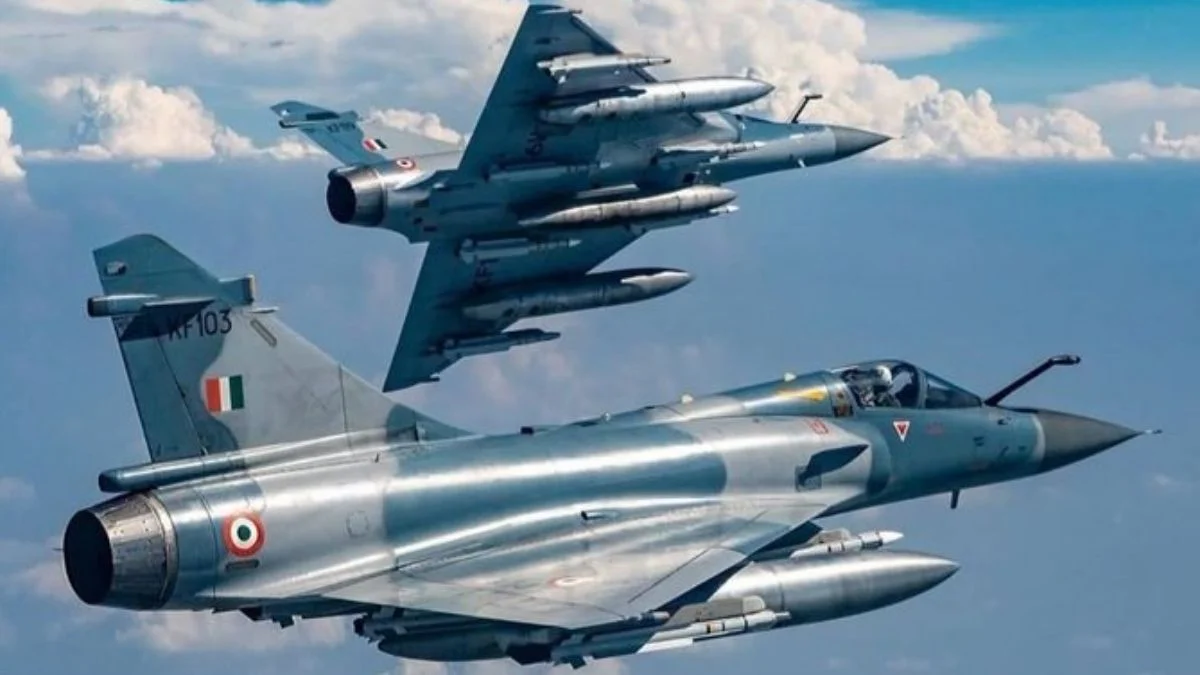
The Mirage Fighter Jet stands as one of the most successful and recognizable families of combat aircraft in modern military aviation history. Designed and built by France’s Dassault Aviation, the Mirage series has served air forces around the world for more than six decades. From the groundbreaking Mirage III of the Cold War era to the advanced multirole Mirage 2000 still flying today, the Mirage Fighter Jet has earned a reputation for speed, agility, reliability, and export success.
This comprehensive guide covers the history, design, key variants, specifications, operators, and combat record of the Mirage Fighter Jet family.
History of the Mirage Fighter Jet
The story of the Mirage Fighter Jet began in the mid-1950s. France sought a lightweight, high-performance interceptor after World War II experiences highlighted the need for independent air power. Dassault responded with the Mirage I and II prototypes, leading to the production Mirage III.
The Mirage III first flew on 17 November 1956 and became the first Western European combat aircraft to sustain Mach 2 in level flight. It entered service with the French Air Force in 1961. The pure delta-wing design proved highly effective and commercially successful, with more than 1,400 Mirage III, 5, and 50 variants produced. These aircraft saw combat with Israel during the 1967 Six-Day War, where they achieved remarkable air superiority.
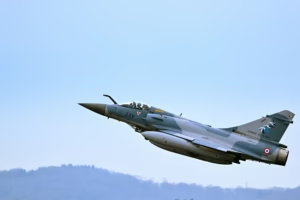
In the 1960s, Dassault developed the Mirage F1, which replaced the pure delta with a conventional swept wing for better low-speed handling and short-field performance. The F1 first flew in 1966 and entered service in 1973. Approximately 720 were built and exported widely.
The modern face of the Mirage Fighter Jet is the Mirage 2000. Developed in the 1970s as a lightweight replacement for the Mirage III and F1, the Mirage 2000 first flew on 10 March 1978 and entered French service in 1984. Around 601 aircraft were produced between 1978 and 2007. It remains in active service with several air forces today.
Design Features of the Mirage Fighter Jet
The signature feature of most Mirage Fighter Jets is the tailless delta wing. This configuration delivers excellent high-speed performance, low drag, and large internal volume for fuel and weapons. Early deltas like the Mirage III had limited maneuverability at low speeds, but the Mirage 2000 solved this with relaxed stability and a digital fly-by-wire flight control system. The result is a highly agile aircraft that retains the classic Mirage silhouette.
Key design elements across the series include:
- Single-engine layout for simplicity and lower operating costs
- Area-ruled fuselage for efficient transonic and supersonic flight
- High thrust-to-weight ratios enabling rapid climb and acceleration
- Progressive improvements in radar, avionics, and weapons integration
The Mirage 2000, for example, is powered by a single SNECMA M53-P2 afterburning turbofan producing approximately 95 kN (21,400 lbf) of thrust with afterburner. It features nine hardpoints capable of carrying up to 6,300 kg of external stores.
Major Variants of the Mirage Fighter Jet
Mirage III / 5 / 50 Family
- Interceptor and ground-attack versions
- Pure delta wing
- Powered by SNECMA Atar turbojets
- Widely exported and licence-built
Mirage F1
- Swept-wing multirole fighter
- Better field performance than pure deltas
- Used extensively in the Middle East and Africa
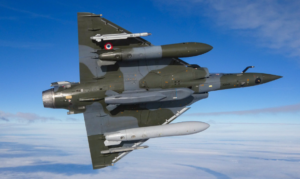
Mirage 2000 Family
- Mirage 2000C: Single-seat air-defense interceptor
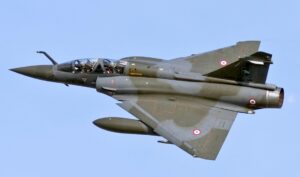
- Mirage 2000B: Two-seat trainer
- Mirage 2000N: Nuclear strike variant (retired from French service)
- Mirage 2000D: Conventional precision-strike aircraft
- Mirage 2000-5 / 2000-9: Advanced multirole versions with improved radar (RDY) and beyond-visual-range missiles
Export customers received tailored versions such as the Indian Mirage 2000H/TH (locally called Vajra) and UAE Mirage 2000-9.
Mirage 2000 Key Specifications
| Parameter | Value |
| Crew | 1 (2 in trainer/strike variants) |
| Length | 14.36 m (47 ft 1 in) |
| Wingspan | 9.13 m (29 ft 11 in) |
| Height | 5.20 m (17 ft 1 in) |
| Empty Weight | Approx. 7,500 kg |
| Max Takeoff Weight | 17,000–17,500 kg |
| Engine | 1 × SNECMA M53-P2 turbofan |
| Max Speed | Mach 2.2 (2,336 km/h) |
| Ferry Range | Approx. 3,335 km with external tanks |
| Service Ceiling | 18,000+ m (59,000+ ft) |
| Armament | 2 × 30 mm DEFA cannons + up to 6,300 kg external stores |
Operators and Combat History
The Mirage Fighter Jet has been operated by more than 20 countries over its lifetime. Current or recent operators of the Mirage 2000 include France, the United Arab Emirates, Taiwan (Republic of China), India, Greece, Egypt, Peru, Qatar, and Ukraine (which received ex-French aircraft).
Combat experience is extensive:
- Israeli Mirage IIIs dominated in the 1967 Six-Day War
- Mirage F1s saw action in various Middle Eastern conflicts
- French Mirage 2000s participated in the Gulf War, Bosnia, Kosovo, Afghanistan, Libya, and Syria
- Indian Mirage 2000s performed precision strikes during the 1999 Kargil War
- UAE Mirage 2000s have flown combat missions in the region
The aircraft’s combination of performance, relatively low cost, and French political independence made it highly attractive on the export market.
Why the Mirage Fighter Jet Remains Relevant
Even decades after its introduction, the Mirage Fighter Jet continues to serve effectively. Continuous upgrades in avionics, radar, electronic warfare systems, and precision weapons have kept later variants competitive. The Mirage 2000’s low operating costs compared with twin-engine fighters and its proven combat record ensure it will remain a valuable asset for many air forces well into the 2030s.
Also Read This : Apple Pay : The Complete Guide to Faster, Safer Contactless Payments
The Mirage Fighter Jet represents a remarkable achievement in aeronautical engineering. From the pure-delta Mirage III that helped redefine air combat in the 1960s to the sophisticated multirole Mirage 2000 still defending skies today, the family has left an indelible mark on aviation history. Its blend of elegant design, high performance, and export success makes the Mirage one of the most important fighter series of the jet age.
View this post on Instagram