Category: News

  • Union Budget 2026 highlights : Key announcements from FM Nirmala Sitharaman

    Union Budget 2026 highlights : Key announcements from FM Nirmala Sitharaman

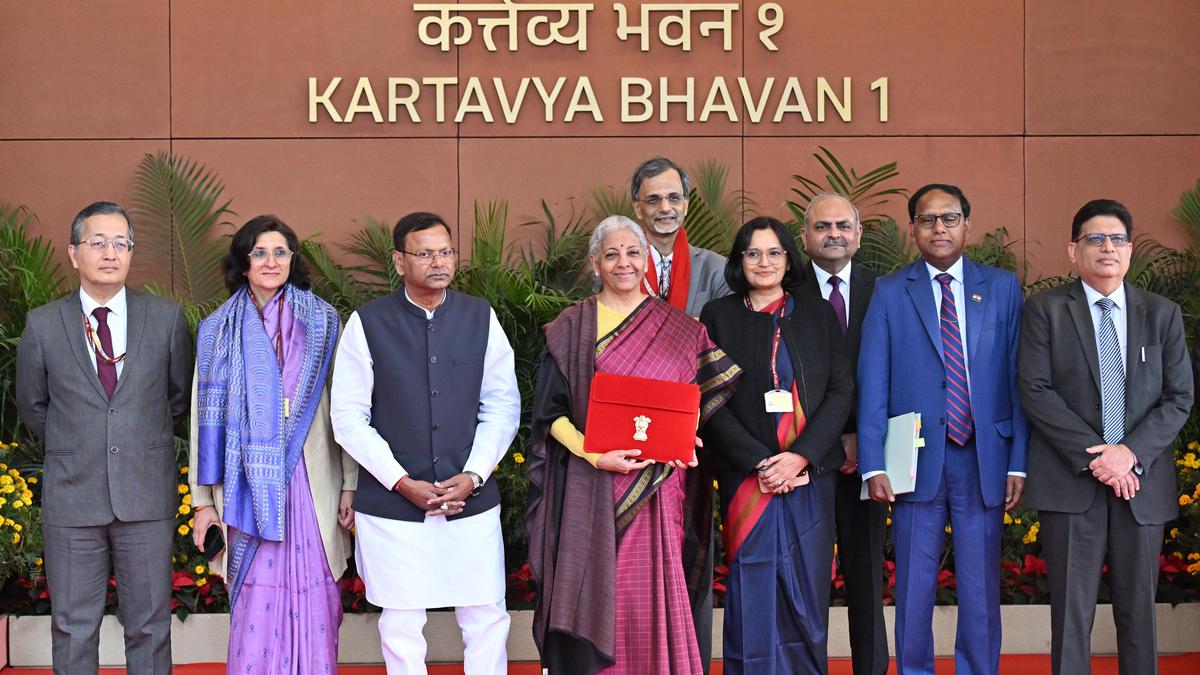
    Union Budget 2026 highlights : The Union Budget 2026-27, presented by Finance Minister Nirmala Sitharaman on February 1, 2026, marks her ninth consecutive budget speech. Tabled in Parliament on a Sunday for the first time in India’s history, this “Yuva Shakti-driven” budget emphasizes the government’s commitment to the poor, underprivileged, and disadvantaged. It draws inspiration from three core Kartavyas (duties):

    • Accelerate and sustain economic growth by boosting productivity, competitiveness, and resilience amid global volatility.
    • Fulfill people’s aspirations and build their capacities to make them strong partners in India’s prosperity.
    • Align with the vision of Sabka Saath, Sabka Vikas — ensuring every family, community, region, and sector has access to resources, amenities, and opportunities.

    Described as a budget of “reforms over rhetoric” and “action over ambivalence,” it prioritizes structural reforms, fiscal discipline, moderate inflation, sustained ~7% growth, and continued public investment to advance toward Viksit Bharat (Developed India).


    View this post on Instagram


    A post shared by AVSPOST (@avspost)

    Fiscal Framework : Prudence Meets Momentum

    The budget 2026 maintains a strong focus on capital expenditure while progressing toward fiscal consolidation.

    • Public Capital Expenditure (Capex): Raised to ₹12.2 lakh crore (approximately 4.4% of GDP) — the highest-ever allocation — up from ₹11.2 lakh crore in BE 2025-26, to sustain infrastructure momentum and crowd in private investment.
    • Fiscal Deficit: Targeted at 4.3% of GDP for FY 2026-27 (down from 4.4% in RE 2025-26).
    • Debt-to-GDP Ratio: Projected at 55.6% in BE 2026-27 (from 56.1% in RE 2025-26), with a long-term goal of 50 ± 1% by 2030.
    • Total Budget Size: Approximately ₹53.5 lakh crore.
    • Non-Debt Receipts and Total Expenditure: Estimated at ₹36.5 lakh crore and ₹53.5 lakh crore, respectively.
    • Net Tax Receipts: Around ₹28.7 lakh crore.

    These parameters reflect continued fiscal prudence while prioritizing growth-enabling investments.

    Budget 2026 : Manufacturing, Infrastructure, and Beyond

    Budget 2026 : Under the first Kartavya, the budget proposes interventions in six major areas:

    • Scaling Up Manufacturing in 7 strategic and frontier sectors.
    • Rejuvenating Legacy Industrial Sectors.
    • Creating Champion MSMEs — including a ₹10,000 crore SME Growth Fund.
    • Powerful Push to Infrastructure.
    • Long-Term Energy Security and reduced critical import dependencies.
    • Developing City Economic Regions (CERs).


    View this post on Instagram


    A post shared by AVSPOST (@avspost)


    Notable announcements include:

    • Biopharma Shakti: ₹10,000 crore over 5 years for domestic biologics and biosimilars production.
    • India Semiconductor Mission (ISM) 2.0: Launch to strengthen equipment, materials, design, and supply chains.
    • Electronics Components Manufacturing Scheme: Outlay increased to ₹40,000 crore.
    • Rare Earth Corridors: Support in states like Odisha, Kerala, Andhra Pradesh, and Tamil Nadu.
    • Infrastructure Highlights:
    • 7 high-speed rail corridors (e.g., Mumbai-Pune, Pune-Hyderabad, Hyderabad-Bengaluru, Hyderabad-Chennai, Chennai-Bengaluru, Delhi-Varanasi, Varanasi-Siliguri).
    • New dedicated freight corridors (including east-west).
    • Operationalization of 20 new National Waterways over 5 years.
    • Seaplane Viability Gap Funding (VGF) to boost indigenous manufacturing.
    • Infrastructure Risk Guarantee Fund for private developers.
    • City Economic Regions: ₹5,000 crore per CER over 5 years.
    • Defence: Record allocation (all-time high of around ₹7.85 lakh crore, up ~15%; capex hiked significantly, e.g., ~21% in some reports to ₹5.9 lakh crore).
    • Other Sectors:
    • Tourism: Upskilling 10,000 guides; reduced TCS on overseas tours; development of 15 archaeological sites; first Global Big Cat Summit; Khelo India Mission for sports skilling and employment.
    • AVGC (Animation, Visual Effects, Gaming, Comics — Orange Economy): AVGC Content Creator Labs in 15,000 schools and 500 colleges.
    • Agriculture: Dhan-Dhaanya Krishi Yojana for high-yield crops; Bharat-Vistaar AI tool.
    • Textiles: Integrated programme with mega parks and export support.


    View this post on Instagram


    A post shared by AVSPOST (@avspost)

    Tax and Customs Reforms : Simplification and Relief

    Budget 2026 : No changes to income tax slabs were announced, continuing stability from prior budgets. Key updates include:

    • New Income Tax Act, 2025: Effective from April 1, 2026, with simplified rules.
    • Middle-Class Reliefs: TCS cuts, new dividend deductions, nil deduction certificates for small taxpayers, ITR filing extension to August 31 for non-audit cases, rationalized penalties/prosecutions, and provident fund rule updates.
    • Securities Transaction Tax (STT): Increased on futures (e.g., to 0.05% from 0.02%).
    • Customs Duties:
    • Reduced from 20% to 10% on personal imports.
    • Exemptions/reductions on capital goods for lithium-ion cells, critical minerals, cancer medicines, sports equipment, leather goods, and seafood.
    • Some items (imported alcohol, coffee) may become costlier.
    • Other: Tax holidays for foreign cloud providers till 2047; MAT reforms; safe harbour enhancements for IT services; buyback taxed as capital gains.

    Overall Assessment

    The Union Budget 2026 – 27 is a continuity-focused, producer-centric document that doubles down on capex-led growth, manufacturing self-reliance, infrastructure, and inclusive reforms rather than short-term populist measures. It aims to build resilience against global uncertainties while empowering youth, MSMEs, and underserved sections.
  • Union Budget 2026 : What Sunday’s Big Reveal Means for Your Wallet

    Union Budget 2026 : What Sunday’s Big Reveal Means for Your Wallet

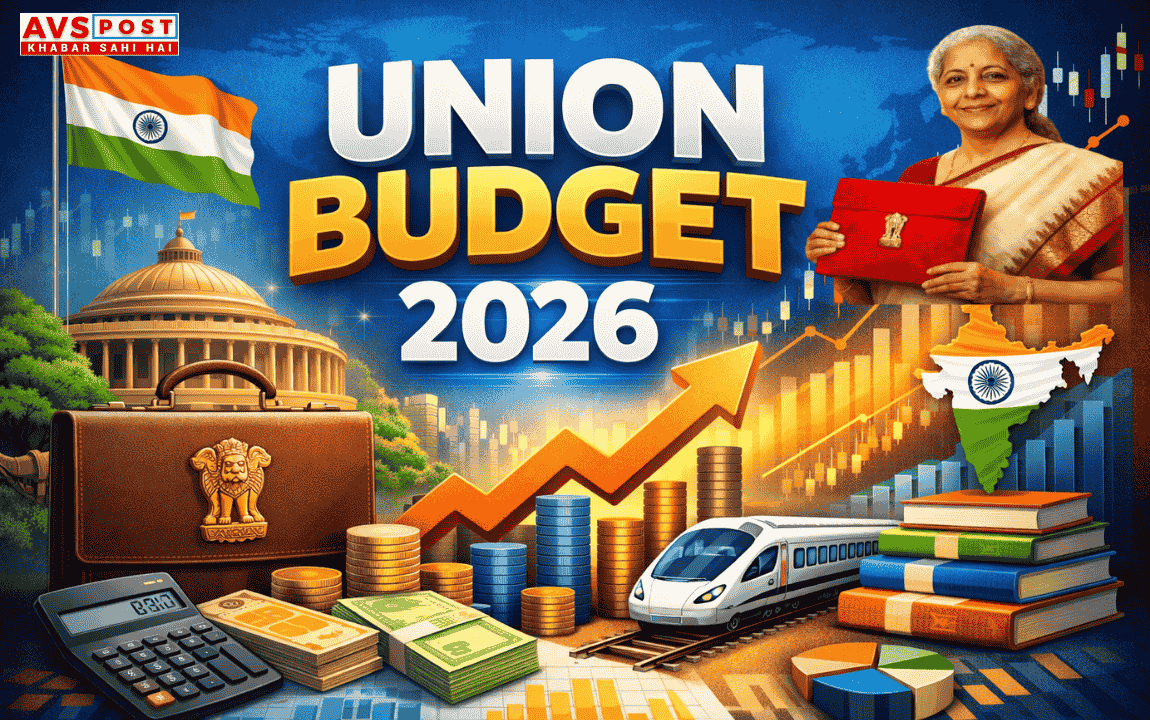
    The Union Budget 2026 – 27 is one of the most anticipated economic events in India, marking a pivotal moment in the country’s journey toward becoming a developed nation (Viksit Bharat) by 2047. With Finance Minister Nirmala Sitharaman set to present her ninth consecutive Budget on Sunday, February 1, 2026, at 11:00 AM in Parliament, this rare Sunday presentation has already sparked widespread discussion.

    As we stand just a day away (on January 30, 2026), here’s a comprehensive look at the context, key expectations, and what this Budget could mean for everyday Indians, businesses, and the broader economy.


    View this post on Instagram


    A post shared by AVSPOST (@avspost)

    The Road to Union Budget 2026: Setting the Stage with the Economic Survey

    The Economic Survey 2025-26, tabled by FM Sitharaman on January 29, 2026, painted an optimistic yet cautious picture of India’s economy. It projects real GDP growth for FY 2026-27 (the year the Budget covers) in the range of 6.8–7.2%, building on the estimated 7.4% growth for FY 2025-26 (as per First Advance Estimates). This positions India as the world’s fastest-growing major economy for the fourth consecutive year.

    Key highlights from the Survey include:

    • Resilient domestic demand, with private consumption contributing ~61.5% of GDP and investment ~30%.
    • Historic low inflation levels and strengthened banking sector health.
    • Medium-term potential growth anchored around 7%, driven by structural reforms, infrastructure push, digital public infrastructure, and productivity gains.
    • Warnings about global uncertainties, including geopolitical tensions, trade fragmentation, potential financial crises (10–20% risk), and impacts from tariffs on labor-intensive sectors.

    The Survey emphasizes shifting focus from demand-led to productivity-led growth, with priorities like fiscal consolidation, higher capital expenditure (capex), human capital investment (education, skilling, healthcare), export competitiveness, and inclusive development.

    Union Budget 2026
    Union Budget 2026

    Why This Budget Matters

    This Budget arrives amid a “Goldilocks” moment—strong growth with controlled inflation—but also global headwinds like U.S. tariffs and rupee pressures. Expectations center on balancing fiscal prudence (likely targeting a deficit around 4.3% of GDP) with measures to boost consumption, jobs, and long-term competitiveness.

    Sitharaman’s speech will outline allocations for sectors, tax policies, and reforms, with documents released digitally on indiabudget.gov.in shortly after.

    Top Expectations from Union Budget 2026

    Union Budget 2026 : Analysts, economists, and industry bodies have outlined several key areas:

    1. Income Tax Relief for the Middle Class While drastic slab changes are unlikely, many hope for:
      • Increase in standard deduction (possibly to ₹1 lakh).
      • Higher exemption limits or tweaks to make the new tax regime more attractive.
      • Relief on TDS for FD interest, rental income, or health insurance (Section 80D). These could provide breathing room amid rising costs and boost consumption.
    2. Capital Expenditure and Infrastructure Push Capex is expected to remain robust (~₹12–12.5 lakh crore, or ~3.2% of GDP), focusing on:
      • Roads, railways, logistics, ports, and urban development (e.g., Multi-Modal Logistics Parks under PM Gati Shakti).
      • Green energy transition, energy storage, and climate-resilient projects.
      • Urban Challenge Fund or similar initiatives to transform cities.
    3. Sector-Specific Boosts
      • Agriculture & Rural Economy: Continued support for climate-resilient tech, exports, and farmer welfare amid trade talks.
      • Manufacturing & Exports: Incentives to counter global tariffs, PLI scheme extensions, and trade agreement benefits.
      • MSMEs & Startups: Easier credit, reduced compliance, and innovation funding.
      • Housing & Real Estate: GST rationalization, affordability measures, and REIT clarity.
      • Digital & AI: Support for data centers, AI infrastructure, and skilling.
    4. Capital Markets & Investors
      • Potential LTCG tax cut (to 10%), STT rollback, or tax parity across instruments to attract foreign inflows.
      • Stability over major surprises to maintain market confidence.
    5. Other Priorities
      • Skilling and employment generation.
      • Healthcare and education investments.
      • Simplified GST/compliance and faster tax dispute resolution.
    Union Budget 2026
    Union Budget 2026

    Where to Watch and Follow

    • Live Telecast: Sansad TV (Lok Sabha/Rajya Sabha channels), DD News, or official YouTube channels of Parliament/Sansad TV.
    • Post-Budget: Full speech, highlights, and documents on indiabudget.gov.in.
    • Stay tuned for sector-wise reactions and market movements immediately after.

    Also Read This : 8th Pay Commission 2026 : Latest Updates, Expected Salary Hikes, Fitment Factor & What Central Government Employees Should Know

    The Union Budget 2026 isn’t just about numbers—it’s a blueprint for sustaining momentum toward a $5+ trillion economy while addressing everyday challenges like jobs, affordability, and global competitiveness. Whether it delivers bold relief or measured continuity, it will shape India’s economic narrative for the year ahead.

  • 8th Pay Commission 2026 : Latest Updates, Expected Salary Hikes, Fitment Factor & What Central Government Employees Should Know

    8th Pay Commission 2026 : Latest Updates, Expected Salary Hikes, Fitment Factor & What Central Government Employees Should Know

    8th Pay Commission 2026 : As of late January 2026, the long-awaited 8th Central Pay Commission (8th CPC) remains a topic of intense discussion among over 50 lakh central government employees, defence personnel, and around 60 lakh pensioners. While many had hoped for immediate salary revisions starting January 1, 2026 (the day after the 7th Pay Commission term ended), the reality is more nuanced. Here’s a clear, updated overview based on recent reports from reliable sources like The Economic Times, India Today, Financial Express, and others.


    View this post on Instagram


    A post shared by AVSPOST (@avspost)

    Current Status of the 8th Pay Commission 

    The 8th Pay Commission has not yet fully kicked in with revised salaries or a new pay matrix. Key developments this month include:

    • The commission’s office is still not fully functional.
    • Staff-side representatives (employee unions) are planning meetings in February 2026 to push their demands.
    • There are reports of vacancies in the commission structure.
    • Most credible analyses now indicate that the commission will take 12–18 months to submit its final recommendations, likely meaning implementation (with arrears from January 1, 2026) could happen in mid-to-late 2027.
    • Some earlier optimistic headlines claiming “effective from January 2026” referred only to the eligibility date for arrears, not immediate pay hikes.
    • Delays are attributed to government processes, economic considerations, and the need for detailed consultations.

    In short: No official new salary list or pay matrix has been released yet. Any tables or exact figures circulating on social media (WhatsApp, Instagram, Facebook) are speculative or unofficial.

    What is the Expected Fitment Factor?

    The fitment factor is the multiplier applied to the existing basic pay (from the 7th CPC) to arrive at the revised basic pay. This single number determines much of the overall hike.

    Current expectations (as of January 2026 reports):

    • Conservative estimates: 1.8 – 2.0 (real hike after inflation ~13%, per some analysts like Kotak Institutional Equities)
    • Moderate projections: 2.15 – 2.28 (commonly discussed in arrears calculators)
    • Optimistic/union demands: 2.57 – 3.25 (employee unions pushing for higher to offset rising costs)
    • Some sources still mention lower ranges like 1.83–2.46

    Higher fitment factors would lead to more substantial increases but depend on government finances, inflation trends (AICPI-IW index), and negotiations.

    8th Pay Commission 2026 : Latest Updates
    8th Pay Commission 2026 : Latest Updates

    Expected Salary Revisions : Level-Wise Projections

    8th Pay Commission 2026 : Here are approximate revised basic pay figures starting from the current 7th CPC minimum (Level 1: ₹18,000). These are projections only — not official.

    • Fitment Factor 2.0 → Minimum basic pay ≈ ₹36,000
    • Fitment Factor 2.15 → Minimum basic pay ≈ ₹38,700
    • Fitment Factor 2.28 → Minimum basic pay ≈ ₹41,040
    • Fitment Factor 2.57 → Minimum basic pay ≈ ₹46,260
    • Higher demands (3.0+) → Could push minimum basic pay to ₹54,000 or more

    For higher levels (e.g., Level 6–10, common for Group B & A posts), the absolute increase would be larger even at moderate fitment factors.

    Gross salary impact (including HRA, DA, TA, etc.) could range from 25–50%+ overall increase, depending on:

    • City classification (X, Y, Z for HRA)
    • Current DA level (already near 60% in early 2026)
    • Allowances revision (some reports suggest merging or enhancing them)

    Arrears would be calculated from January 1, 2026, once implemented — potentially a significant one-time payout for Levels 1–5 employees.

    What Should Central Government Employees Do Now?

    1. Stay updated from official sources — Department of Personnel & Training (DoPT), Ministry of Finance, or Press Information Bureau (PIB) notifications.
    2. Avoid unverified viral lists — Many show exaggerated figures (e.g., Peon ₹45,000+, Teacher ₹85,000) that aren’t backed by any commission report.
    3. Track union developments — National Council–Joint Consultative Machinery (NC-JCM) staff side is actively negotiating.
    4. Prepare financially — If arrears come later, the lump sum could help with major expenses, but don’t count on it immediately.

    Also Read This : UGC Equity Rules 2026

    8th Pay Commission 2026 holds the promise of meaningful relief amid rising living costs, but patience is still required. Realistic expectations point to a fitment factor in the 2.0–2.5 range, delivering a solid (though not dramatic) hike once finalized. Keep an eye on February 2026 meetings and any commission announcements in the coming months.

  •  EU India Free Trade Deal :The ‘Mother of All Deals’ Finally Signed!

     EU India Free Trade Deal :The ‘Mother of All Deals’ Finally Signed!

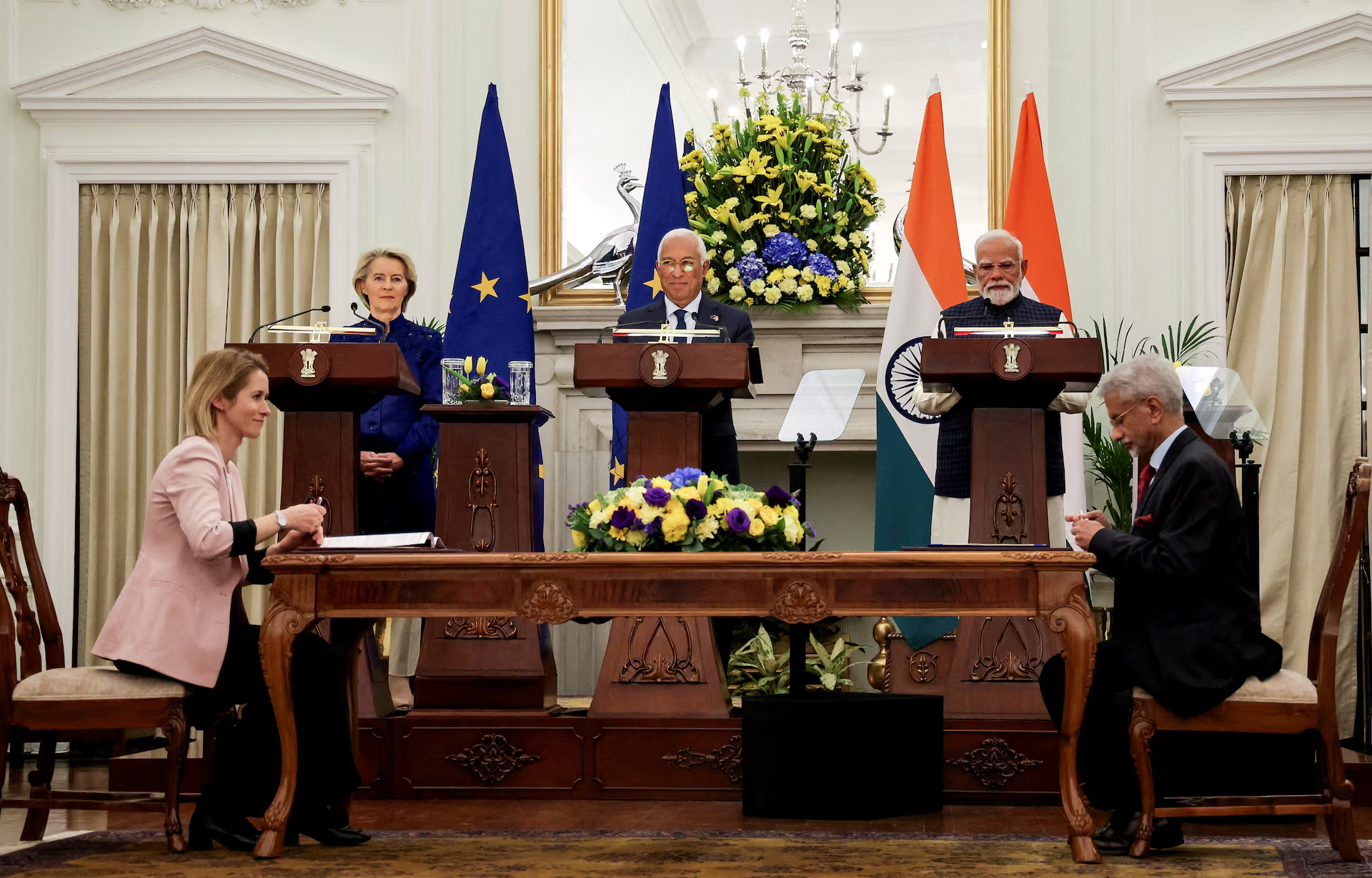
    EU India Free Trade Deal : In a historic moment for global trade, India and the European Union have finally sealed one of the most significant free trade agreements (FTA) in recent history. On January 27, 2026, during the 16th India-EU Summit in New Delhi, negotiations for the long-awaited EU-India FTA were officially concluded after nearly two decades of intermittent discussions. Relaunched in 2022, the talks accelerated dramatically in the final months, culminating in what European Commission President Ursula von der Leyen famously called the “mother of all deals.”

    This agreement creates a massive free trade zone encompassing nearly 2 billion people and roughly 25% of global GDP—equivalent to a combined market worth about $27 trillion. It marks a strategic pivot for both sides amid shifting geopolitics, supply chain disruptions, and uncertainties in global trade dynamics.

     EU India Free Trade Deal
    EU India Free Trade Deal

    Background of the Negotiations

     EU India Free Trade Deal : The EU and India first launched FTA talks back in 2007, but progress stalled in 2013 due to differences over issues like market access in agriculture, automobiles, and services. The negotiations were revived in June 2022 with renewed political commitment from both sides. Parallel discussions on an Investment Protection Agreement and a Geographical Indications (GIs) Agreement also progressed.

    The breakthrough came amid accelerated efforts in late 2025 and early 2026, driven by shared interests in diversifying trade partnerships and building resilient supply chains. The deal was announced and celebrated at the summit attended by Prime Minister Narendra Modi, Ursula von der Leyen, and European Council President António Costa.

     EU India Free Trade Deal
    EU India Free Trade Deal

     EU India Free Trade Deal : Key Highlights of the Agreement

    The FTA is comprehensive, covering goods, services, investment facilitation, sustainable development, and more. Here are the main features:

    • Tariff Reductions : Tariffs will be eliminated or significantly reduced on 96.6% of traded goods by value. This is expected to double EU exports to India by 2032 and save European companies billions in duties. Many industrial products—such as iron and steel, plastics, chemicals, pharmaceuticals, automobiles, spirits, and textiles—will see tariffs cut to zero.
    • Benefits for India : Indian exports in textiles, garments, gems and jewellery, leather, footwear, marine products, chemicals, plastics, sports goods, toys, tea, coffee, spices, and processed foods gain preferential or zero-duty access to the vast EU market. Sensitive sectors like dairy, cereals, and poultry remain protected with safeguards.
    • Services and Mobility : The EU opens 144 subsectors to Indian service providers, while India opens 102 to EU firms, including financial services, maritime transport, and telecommunications. Provisions support mobility for professionals and seasonal workers.
    • Other Provisions : The deal includes strong rules on trade facilitation, customs cooperation, intellectual property, transparency, labor rights, environmental standards, and gender equality. It features a bilateral safeguard mechanism for temporary protections if surges harm domestic industries, and SME-friendly measures like dedicated contact points.
    • Complementary Pacts : Alongside the FTA conclusion, India and the EU signed a security and defence partnership and advanced labor mobility arrangements.

    Expected Economic Impact

     EU India Free Trade Deal : This deal is poised to transform bilateral trade, which already stands at substantial levels but has huge untapped potential. EU goods exports to India could surge, while Indian sectors like textiles and engineering goods gain deeper penetration into Europe. It strengthens supply chain resilience, boosts MSMEs, and supports innovation partnerships. Officials project significant growth in exports, job creation, and investment flows.

     EU India Free Trade Deal
    EU India Free Trade Deal

    Next Steps and Timeline

    While negotiations are concluded, the full legal text requires final scrubbing, translation into all EU languages, and ratification. This includes approval by EU member states, the European Parliament, and India’s cabinet. Commerce Minister Piyush Goyal expressed optimism that the agreement could enter into force by the end of 2026.


    View this post on Instagram


    A post shared by AVSPOST (@avspost)

    Separate negotiations on the Investment Protection Agreement and Geographical Indications continue.

    Also Read This : Sunetra Pawar : A Life of Resilience, Service, and Legacy in the Shadow of Tragedy

    EU India Free Trade Deal : The EU-India FTA is more than a trade pact—it’s a blueprint for shared prosperity, strategic partnership, and stability in a turbulent world. As Prime Minister Modi noted, it represents India’s biggest and most comprehensive FTA yet, while von der Leyen hailed it as history in the making. In an era of protectionism and uncertainty, this deal underscores the power of win-win cooperation between two major democracies.

  • Sunetra Pawar : A Life of Resilience, Service, and Legacy in the Shadow of Tragedy

    Sunetra Pawar : A Life of Resilience, Service, and Legacy in the Shadow of Tragedy

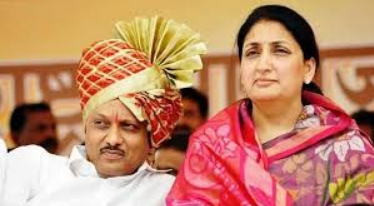
    Sunetra Pawar : Today, as the state observes three days of mourning following the heartbreaking plane crash that claimed the life of Deputy Chief Minister Ajit Pawar and four others near Baramati Airport, the spotlight naturally turns to his wife, Sunetra Pawar—a woman who has quietly yet powerfully carved her own path in public life, environmental activism, and politics.

    Sunetra Pawar, the Rajya Sabha MP from Maharashtra and Chairperson of Baramati Hi-Tech Textile Park Ltd., has long been more than just the spouse of one of the state’s most influential leaders. She is a dedicated environmentalist, social worker, and now, in this moment of profound grief, a symbol of the Pawar family’s enduring strength.


    View this post on Instagram


    A post shared by AVSPOST (@avspost)

    From Baramati Roots to Environmental Leadership

    Born into a politically connected family as the sister of former state minister and Lok Sabha MP Padamsinh Patil, Sunetra has always been deeply tied to rural Maharashtra. In 2010, she founded the Environmental Forum of India (EFOI), an NGO committed to promoting organic farming, eco-villages, clean energy initiatives, and sustainable rural development. Starting from her home base in Baramati, the organization has expanded to advocate for environmental awareness, eco-friendly festivals, and community-led conservation efforts.

    Her work has earned her accolades, including the Green Warrior Award, recognizing her as a true champion of sustainability in a state where agriculture and ecology often intersect with politics.

    As Chairperson of the Baramati Textile Company, she has also championed economic empowerment through industry, blending modern textile innovation with local employment opportunities.

    Sunetra Pawar : Stepping into the Political Arena

    In 2024, Sunetra contested the Lok Sabha seat from Baramati—the Pawar family’s traditional stronghold—on behalf of the Ajit Pawar-led Nationalist Congress Party (NCP) faction. Though she faced a high-profile contest against her sister-in-law Supriya Sule (from the Sharad Pawar-led NCP-SP), the election highlighted her growing role in the family’s political legacy.

    Currently serving as a Rajya Sabha member, Sunetra has focused on issues like women’s empowerment, rural education (as a trustee of Vidya Pratishthan), and sustainable development. She is also associated with the World Entrepreneurship Forum (France) as a think tank member since 2011.

    A Family in Mourning

    Ajit Pawar and Sunetra Pawar shared a partnership that balanced high-stakes politics with family life. They have two sons: Parth Pawar, who has contested elections in the past (including from Maval in 2019), and Jay Pawar, who maintains a relatively private profile.

    Sunetra Pawar
    Sunetra Pawar and Ajit Pawar shared a partnership that balanced high-stakes politics with family life

    The tragic crash on January 28, 2026, occurred as Ajit was traveling from Mumbai to Baramati for election-related rallies ahead of local body polls. The Learjet 45 attempted a second landing approach before the fatal incident. No survivors were reported from the five on board.

    In the immediate aftermath, Sunetra—along with sons Parth and Jay, Supriya Sule, and other family members—rushed from Delhi (where they were attending Parliament’s budget session) to Baramati. The Pawar family, despite past divisions, has come together in grief, with leaders from across parties expressing condolences.

    Prime Minister Narendra Modi remembered Ajit Pawar as a “leader of the people” with a strong grassroots connect, while Maharashtra CM Devendra Fadnavis announced state mourning.

    Strength in Service

    In the wake of this unimaginable loss, Sunetra Pawar stands at a crossroads. Speculation has already begun about her potential role in leading the NCP faction her husband built, or bridging divides within the broader Pawar ecosystem. Her background in grassroots activism, environmental causes, and parliamentary experience positions her uniquely to continue the legacy of service to Maharashtra’s people.

    Yet, today is not about speculation—it’s about honoring a shared life of dedication and offering support to a family that has given so much to public life.

    Sunetra Pawar’s journey—from founding an NGO dedicated to a greener future, to stepping boldly into electoral politics—reminds us that leadership often emerges from quiet, consistent effort rather than just spotlight moments.

    Also Read This : Ajit Pawar plane crash

    In this hour of sorrow, Maharashtra and India stand with her, her sons, and the entire Pawar family. May her resilience inspire continued work toward the sustainable, inclusive Maharashtra she and Ajit envisioned.

    Om Shanti.

  • A.R. Rahman : The Musical Genius and His Recent Controversy

    A.R. Rahman : The Musical Genius and His Recent Controversy

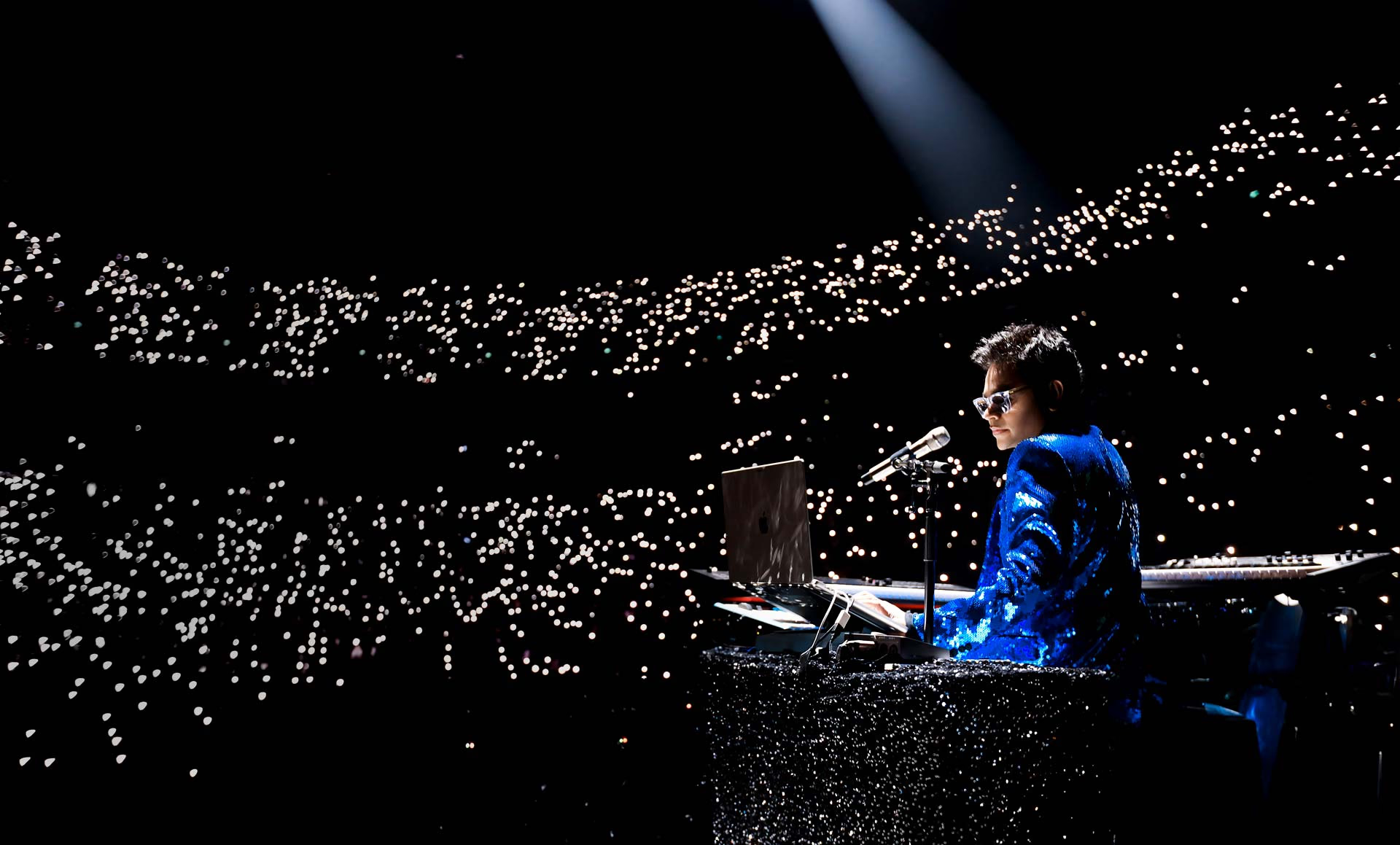
    A.R. Rahman, widely known as the “Mozart of Madras” or “Isai Puyal” (Musical Storm), is one of the most iconic figures in Indian music. Born Allah Rakha Rahman on January 6, 1967 (originally A.S. Dileep Kumar), he has transformed film music by fusing Indian classical traditions with electronic, world, and orchestral sounds. With over 100 film scores in Tamil, Hindi, and international projects, Rahman continues to inspire generations.

    Major Achievements

    • Two Academy Awards: For Slumdog Millionaire (2008) – Best Original Score and Best Original Song (“Jai Ho”).
    • Multiple Grammys, Golden Globes, BAFTAs, and India’s Padma Vibhushan honor.
    • His compositions have sold over 150 million records worldwide.
    A.R. Rahman
    A.R. Rahman

    His career took off with Mani Ratnam’s Roja (1992), followed by timeless scores in films like Bombay, Dil Se, Taal, Lagaan, and Jodhaa Akbar.

    A.R. Rahman in Controversy Over Bollywood Comments

    In mid-January 2026, A.R. Rahman sparked a major controversy during an interview with BBC Asian Network. Discussing fewer Bollywood opportunities over the past eight years, he attributed it to a “power shift” in the industry, where “non-creative people” now hold decision-making power. He suggested this “might have been a communal thing also,” though not directly confronted to him. Rahman also described some recent films, like Chhaava, as “divisive.”

    A.R. Rahman
    A.R. Rahman

    The remarks drew sharp backlash, particularly from right-wing sections on social media, with accusations of playing the victim card and calls for boycotts. Bhajan singer Anup Jalota controversially advised Rahman to “reconvert to Hinduism” for more work, while others like lyricist Manoj Muntashir countered by highlighting Muslim superstars like Shah Rukh Khan, Salman Khan, and Aamir Khan.

    Rahman quickly issued a clarification video, stating his intentions were misunderstood and he never meant to hurt anyone. He reaffirmed his love for India, saying he feels “blessed to be Indian,” thanked Prime Minister Narendra Modi for supporting the entertainment industry, and ended with “Jai Hind, Jai Bharat.” Support came from family, collaborators, and many fans who celebrated his contributions.

    A.R. Rahman : Upcoming Projects

    Amid the storm, Rahman remains focused on exciting work. He is collaborating with Hollywood legend Hans Zimmer on the music for Nitesh Tiwari’s ambitious Ramayana trilogy. Part 1, starring Ranbir Kapoor as Ram, Sai Pallavi as Sita, and Yash as Ravana, is slated for Diwali 2026 release.

    A.R. Rahman : Upcoming Projects
    A.R. Rahman : Upcoming Projects

    Rahman has described the project as “terrifying” yet exhilarating, aiming to create something iconic. He emphasized unity: “Ramayana is Hindu, I’m Muslim, Hans Zimmer is Jewish – but we value goodness and higher ideals.” This collaboration promises to take India’s cultural heritage global.

    Also Read This : Happy Patel Khatarnak Jasoos : Vir Das’ Spy Comedy Set to Hit Theaters This Week!

    A.R. Rahman‘s music transcends boundaries, religions, and controversies. No matter the debates, his artistry continues to unite and uplift millions. His melodies remain the ultimate testament to his genius.

  • Nitin Nabin Takes Charge : A New Era Begins for the BJP

    Nitin Nabin Takes Charge : A New Era Begins for the BJP

    Today marks a historic day in Indian politics as 45-year-old Nitin Nabin, a dynamic leader from Bihar, formally took charge as the National President of the Bharatiya Janata Party (BJP). Elected unopposed, he becomes the youngest person ever to lead the world’s largest political party and the first leader from Bihar to hold this top position.

    The ceremony took place at the BJP headquarters in New Delhi during the ‘Sangathan Parv’ celebrations. It was attended by Prime Minister Narendra Modi, Home Minister Amit Shah, Defence Minister Rajnath Singh, former President JP Nadda, Union Minister Nitin Gadkari, several Chief Ministers, and other senior leaders. The event was filled with energy and optimism as the party ushered in this leadership transition.

    Nitin Nabin National President of the Bharatiya Janata Party (BJP)
    Nitin Nabin National President of the Bharatiya Janata Party (BJP)

    The Rise of Nitin Nabin: From Grassroots to National Leadership

    Born on May 23, 1980, Nitin Nabin comes from a political family in Bihar. He is the son of the late Nabin Kishore Prasad Sinha, a veteran BJP leader and four-time MLA. Nabin entered politics early, winning his first election as MLA in 2006 and securing five consecutive terms since then. He has served as a cabinet minister in Bihar, managing important portfolios, and is respected for his strong organisational abilities and administrative skills.

    His ascent gained momentum in December 2025 when he was appointed as the National Working President, a role that clearly indicated the party’s trust in him to succeed JP Nadda.

    Key Moments from the Ceremony

    In a memorable gesture, Prime Minister Narendra Modi congratulated Nitin Nabin, humorously calling him his “boss” in party affairs while positioning himself as a dedicated party worker. Modi highlighted Nabin’s connection to the younger generation, noting that he represents those who have grown up witnessing India’s progress from the radio era to the age of AI and advanced technology.

    Other leaders praised Nabin’s dedication, hard work, and commitment to the party’s ideals.

    Nitin Nabin National President of the Bharatiya Janata Party (BJP)
    Nitin Nabin National President of the Bharatiya Janata Party (BJP)

    What Lies Ahead for the BJP

    Nitin Nabin’s leadership comes at an important juncture, bringing fresh energy and a focus on youth to the party. With his deep roots in Bihar—a crucial political state—and proven expertise in building organisation, he is poised to strengthen the BJP’s grassroots network and broaden its appeal in preparation for upcoming elections.

    Also Read This : Anvesha Satellite : A Promising Hyperspectral Mission Lost in PSLV-C62 Failure

    As the youngest president in BJP history, Nabin symbolises the perfect mix of experience and youthful vigour.

    In his speech, Nabin thanked the party leadership and pledged to work tirelessly to meet the people’s expectations under Prime Minister Modi’s guidance.

  • Saurabh Dwivedi Resign : Saurabh Dwivedi left Lallantop, The Voice of Modern Hindi Journalism

    Saurabh Dwivedi Resign : Saurabh Dwivedi left Lallantop, The Voice of Modern Hindi Journalism

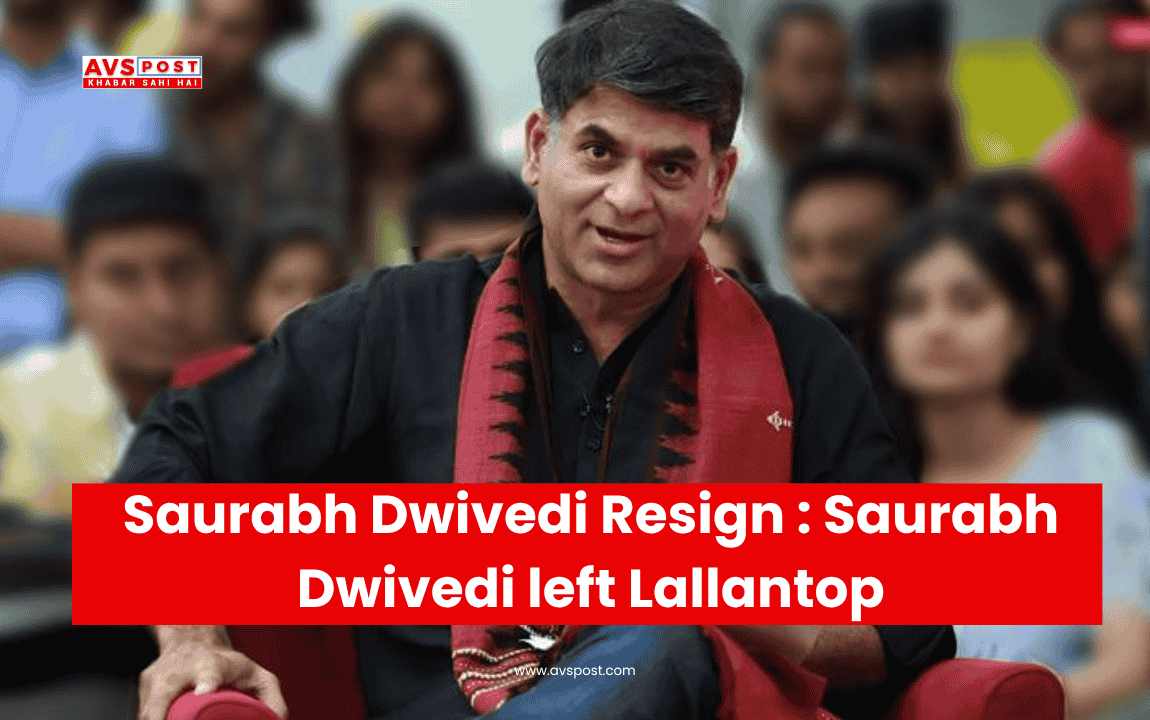
    Saurabh Dwivedi Resign : Saurabh Dwivedi left Lallantop, one of India’s most recognizable Hindi journalists, has long been synonymous with The Lallantop, the popular digital news platform known for its witty, accessible, and bold political coverage. Born on April 22, 1983, in the small village of Chamari in Jalaun district, Uttar Pradesh, Saurabh turned 42 in 2025. His journey from a camera-shy child in rural UP to a leading media figure is a story of passion, perseverance, and a deep-rooted love for storytelling.

    Family Background: Roots in Education and Politics

    Saurabh hails from a traditional Brahmin family with influences in education and local politics. His father, Ravikant Dwivedi, is a retired professor (and in some accounts, associated with political activities, including past affiliations with parties like BJP or Congress). His paternal grandfather, Mataprasad Dwivedi (also known as Mata Prasad Chamari), was a prominent member of the Indian National Congress and held significant influence in the surrounding villages.

    Saurabh has an elder brother, Abhay Dwivedi, who works as a director at Infopark in Jalaun. Family members affectionately call him “Shibbu.” Growing up in a modest, value-driven household, Saurabh was deeply influenced by Hindi literature and social issues from a young age. Interestingly, as a child, he was extremely camera-shy—so much so that he would cry if anyone tried to photograph him—a stark contrast to his confident on-screen presence today.

    Saurabh Dwivedi Resign : Saurabh Dwivedi left Lallantop
    Saurabh Dwivedi Resign : Saurabh Dwivedi left Lallantop

    In 2010, Saurabh married his long-time partner, Gunjan Dwivedi, whom he often describes as his best friend, harshest critic, and strongest support system. The couple has two children: a daughter named Gaura and a son (whose name is kept private). Saurabh maintains a low profile about his personal life, occasionally sharing glimpses on social media, but prioritizes keeping his family away from the public spotlight.

    Saurabh Dwivedi : Education and Early Influences

    Saurabh’s early schooling took place in Orai and Kanpur, including institutions like Saraswati Shishu Mandir and Pandit Deen Dayal Upadhyaya Sanatan Dharma Vidyalaya (a boarding school). He graduated in Mathematics from Dayanand Vedic College (DVC), Orai—under some family pressure—before following his heart to Jawaharlal Nehru University (JNU) in Delhi. There, he pursued an MA in Hindi Literature (and later an MPhil on the 1857 uprising). A professor at JNU, impressed by his writing, encouraged him to enter journalism, sparking his career shift.

    Current Update: A New Chapter Begins

    As of early January 2026, Saurabh Dwivedi has stepped down from his roles at the India Today Group after nearly 12 years. He resigned as the founding editor of The Lallantop and editor of India Today Hindi on January 5, 2026, marking the end of an era for the platform he built from the ground up in 2016. Under his leadership, The Lallantop grew into a youth favorite, boasting millions of subscribers and views with shows like The Lallantop Show, Netanagari, and long-format interviews with political heavyweights.

    Saurabh Dwivedi Resign : Saurabh Dwivedi left Lallantop
    Saurabh Dwivedi Resign : Saurabh Dwivedi left Lallantop

    In his farewell post on social media, Saurabh expressed gratitude to The Lallantop for giving him “identity, lessons, and courage,” and hinted at a brief “leisure break” before embarking on a “new journey.” He has indicated interest in exploring creative opportunities outside the India Today Group, possibly a new platform focused on Hindi journalism. Editorial leadership at The Lallantop has transitioned to Kuldeep Mishra, a long-time team member.

    Also Read This : Tata Punch Facelift 2026 : Launching 13 January – Everything You Need to Know

    Throughout 2025, Saurabh remained active, moderating high-profile debates (including one on the existence of God between Javed Akhtar and Shamail Nadwi), appearing on shows like The Great Indian Kapil Show, and receiving awards for his contributions to journalism.

    Saurabh Dwivedi‘s departure has sparked widespread discussion in media circles, with many viewing it as the start of an exciting independent phase for one of Hindi digital media’s most influential voices. Whatever comes next, his legacy in making news engaging and relatable for millions of Hindi-speaking audiences is undeniable. We wish him the best in his new beginnings!

  • US Strikes Venezuela : Trump Announces Nicolás Maduro Captured and Flown Out of Country

    US Strikes Venezuela : Trump Announces Nicolás Maduro Captured and Flown Out of Country

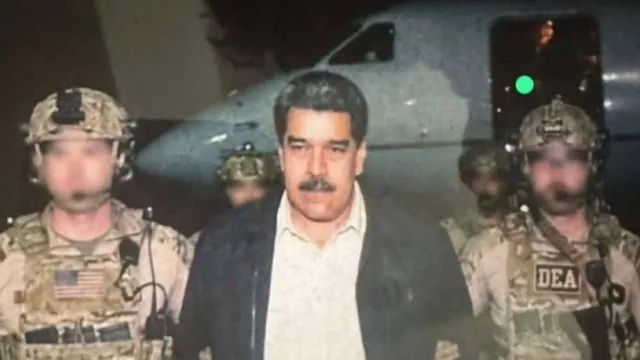
    US Strikes Venezuela : The world woke to one of the most shocking geopolitical developments in recent memory: the United States launched a large-scale military operation inside Venezuela, resulting in the reported capture and extraction of President Nicolás Maduro and his wife, Cilia Flores.

    President Donald Trump made the stunning announcement directly on Truth Social:

    “The United States of America has successfully carried out a large scale strike against Venezuela and its leader, President Nicolás Maduro, who has been, along with his wife, captured and flown out of the Country. This operation was done in conjunction with U.S. Law Enforcement. Details to follow.”

    The post, timestamped in the pre-dawn darkness, confirmed what eyewitnesses in Caracas had already begun sharing: explosions rocked key military installations, including the massive Fuerte Tiuna complex and La Carlota airbase, accompanied by low-flying aircraft and widespread power outages.

    US Strikes Venezuela : Timeline of the Night’s Events

    The operation unfolded rapidly:

    • Around 2:00 a.m. local time, multiple blasts were heard across Caracas.
    • Fires broke out at strategic military sites, with smoke visible from several neighborhoods.
    • U.S. special operations forces — reportedly including Delta Force and supported by elite aviation units — executed the ground raid to apprehend Maduro.
    • Within hours, Trump declared the mission a success, with Maduro and Flores reportedly airborne and en route out of the country.

    U.S. officials later indicated that Maduro would face trial in New York on long-standing narco-terrorism charges, including his alleged leadership of the “Cartel de los Soles.”

    US Strikes Venezuela
    US Strikes Venezuela

    This marks the most direct U.S. intervention in Latin America since the 1989 invasion of Panama — and the first time a sitting Latin American president has been captured in such a manner.

    Escalation Leading to the Strikes

    The Trump administration had steadily intensified pressure on Maduro since mid-2025:

    • Designation of the Maduro government-linked network as a foreign terrorist organization.
    • A $50 million bounty on Maduro’s head.
    • Repeated strikes on suspected drug-trafficking vessels in the Caribbean and eastern Pacific (over 30 boats destroyed).
    • Seizure of Venezuelan oil tankers and an effective blockade.
    • Deployment of major naval assets, including the USS Gerald R. Ford carrier group.

    The official rationale: combating narco-trafficking and transnational crime. Critics argue it was a prelude to regime change aimed at Venezuela’s vast oil reserves.

    Venezuela’s Response and Power Vacuum

    US Strikes Venezuela : In Caracas, Vice President Delcy Rodríguez quickly assumed a public leadership role, appearing on state television to demand “immediate proof of life” for Maduro and Flores. The government declared a national state of emergency, condemned the action as “imperialist aggression,” and called for citizens to mobilize in defense of the Bolivarian Revolution.

    Defense Minister Vladimir Padrino López promised a “massive military deployment,” but with Maduro removed, questions loom over the chain of command and whether the armed forces will remain unified.

    Global Reactions: A Polarized World

    The international community split sharply:

    • Condemnation from Russia, Iran, Cuba, and Bolivia — describing it as a violation of sovereignty and “state terrorism.”
    • Support from Argentina’s President Javier Milei, who celebrated with his signature phrase: “¡Viva la libertad, carajo!”
    • Caution from European nations like Spain (offering mediation), Germany, and Italy (monitoring closely).
    • Regional concern — Colombia’s President Gustavo Petro deployed troops to the border and requested an emergency UN Security Council meeting.
    US Strikes Venezuela
    US Strikes Venezuela

    What Happens Next?

    US Strikes Venezuela, As President Trump prepares to address the nation from Mar-a-Lago, several uncertainties remain:

    • Where exactly is Maduro being held?
    • Will this lead to a swift transition, prolonged chaos, or a new U.S.-aligned government?
    • How will oil markets and regional stability be affected?

    Also Read This : Startup Trends in India 2026 : Top Opportunities & Predictions You Can’t Ignore

    US Strikes Venezuela : January 3, 2026, may go down as the day the long Venezuelan crisis reached its most explosive climax. Whether it brings a “new dawn” for Venezuela — as U.S. officials claim — or ignites further conflict is still unfolding.

    This is a rapidly developing story. Stay tuned for updates as more details emerge from Caracas, Washington, and the international stage.

  • Dr. S. Jaishankar Powerful Message 2026 : Arunachal Pradesh, Pakistan & India’s Firm Stand on Sovereignty

    Dr. S. Jaishankar Powerful Message 2026 : Arunachal Pradesh, Pakistan & India’s Firm Stand on Sovereignty

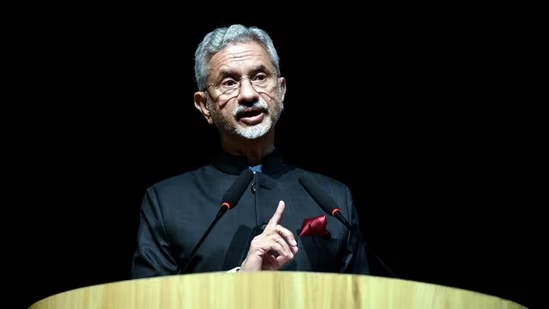
    Dr. S. Jaishankar Powerful Message : External Affairs Minister Dr. S. Jaishankar delivered one of the clearest and most assertive statements of India’s foreign policy in recent years. Speaking at the inauguration of Shaastra 2026 at IIT Madras, he addressed two burning issues that define India’s neighbourhood challenges today — Arunachal Pradesh’s unbreakable status as Indian territory and Pakistan’s continued sponsorship of terrorism.

    Here is the complete essence of what Dr. Jaishankar conveyed — in simple, powerful words that every Indian should understand.

    Dr. S. Jaishankar Powerful Message 2026

    1. Arunachal Pradesh is India — Forever

    Dr. Jaishankar left absolutely no room for ambiguity:

    “Arunachal Pradesh is, and will always remain, an integral and inalienable part of India.”

    He was directly responding to the November 2025 Shanghai airport incident in which an Indian citizen from Arunachal Pradesh was harassed, detained for hours, and repeatedly told that her state belongs to China. India had already lodged a strong diplomatic protest.

    The minister’s message was blunt and final:

    • No amount of map-making
    • No coercive diplomacy
    • No pressure tactics
    • No renaming exercise

    …will ever change the ground reality.

    Arunachal Pradesh has been, is, and will remain Indian territory — full stop.

    Dr. S. Jaishankar Powerful Message 2026
    Dr. S. Jaishankar Powerful Message 2026

    2. Pakistan: The “Bad Neighbour” Who Sponsors Terrorism

    Dr. Jaishankar described Pakistan in the sharpest terms possible:

    “Pakistan is a bad neighbour that has deliberately, consistently and without any remorse used terrorism as an instrument of state policy for decades.”

    He reminded everyone of a very important historical gesture India once made:

    India signed the Indus Waters Treaty in 1960 — one of the most generous water-sharing agreements in the world — as an act of good neighbourliness.

    But good neighbourliness requires reciprocity.

    When a neighbour chooses terrorism instead of peace for over seven decades, the basic premise of the relationship collapses.

    His exact words carried a very strong implication:

    “You cannot expect water-sharing generosity and normal cooperation while you continue to sponsor terrorism against India.”

    3. India Will Decide — Not Anyone Else

    Perhaps the most powerful line of the entire speech was this:

    “How we will defend our people, how we will respond to terrorism — that decision belongs to India alone. No one else has the right to tell us what we should do or should not do.”

    This single sentence sums up the new confident India of 2026:

    • We will not seek permission
    • We will not wait for international approval
    • We will not accept lectures on “restraint”

    When national security is at stake, India will act — decisively, proportionately, and on its own terms.

    Dr. S. Jaishankar Powerful Message 2026
    Dr. S. Jaishankar Powerful Message 2026

    4. India’s Clear Neighbourhood Formula in 2026

    Dr. Jaishankar presented a very straightforward two-track policy:

    • With good neighbours → Deep cooperation, connectivity, development partnership, humanitarian assistance
    • With bad neighbours → Zero tolerance for hostility, especially state-backed terrorism

    Simple. Crystal clear. Non-negotiable.

    Why This Speech Matters So Much in 2026

    1. It tells the youth of India that their country is strong, self-assured and will never compromise on core sovereignty issues.
    2. It tells China that cartographic aggression and passport politics will never succeed.
    3. It tells Pakistan that the patience of decades has limits — and those limits have been crossed multiple times.
    4. It tells the world that sovereign India of 2026 will protect its people without apology or hesitation.

    Also Read This : Startup Trends in India 2026 : Top Opportunities & Predictions You Can’t Ignore

    Final Takeaway

    Dr. S. Jaishankar Powerful Message from IIT Madras on 2nd January 2026 were not just a speech — they were a national resolve put into words.

    Arunachal Pradesh is India.

    Terrorism will never be tolerated.

    India’s response will be decided in New Delhi — nowhere else.

    In 2026, India speaks the language of firm resolve, strategic clarity, and complete self-respect.