Tag: space tourism

  • Blue Origin: what is it, its latest project (NS-31 mission) details, and more.

    Blue Origin: what is it, its latest project (NS-31 mission) details, and more.

    Blue Origin: Blue Origin is an American private aerospace company founded in September 2000, in Kent, Washington, USA by Jeff Bezos, the founder of Amazon. Its mission is to make space travel more accessible and sustainable with the long-term goal of enabling millions of people to live and work in space. It is one of the leading companies in the new space race, along with SpaceX and Virgin Galactic. It is helping push the boundaries of what’s possible in commercial spaceflight, space tourism, and future space colonization.

    Blue Origin
    Blue Origin

    What is the slogan of this company?

    The slogan of Blue Origin is “Gradatim Ferociter,” which is Latin for “Step by Step, Ferociously.” It reflects the company’s philosophy of making steady, determined and progress toward space exploration.

    What is the slogan of this company?
    What is the slogan of this company?

    Details on its latest project?

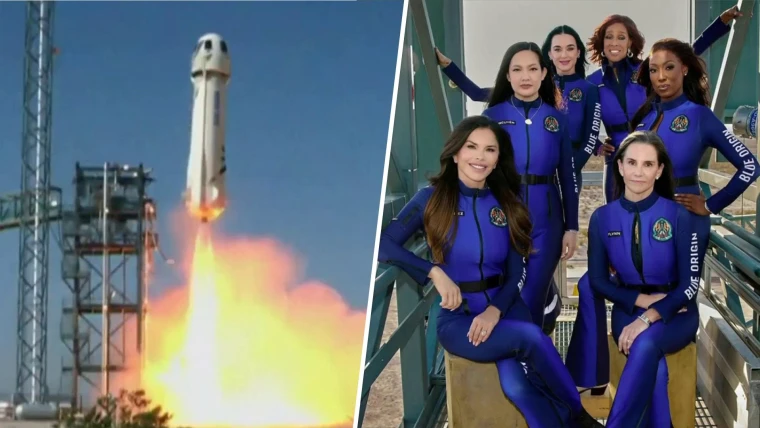
    On April 14, 2025, Blue Origin launched its NS-31 mission, marking a historic milestone with the first all-female crew since 1963. The flight used the reusable New Shepard suborbital rocket, which took the crew beyond the Kármán line—62 miles (100 km) above Earth, the internationally recognized boundary of space. During the 11-minute journey, the crew experienced weightlessness and breathtaking views of Earth. This was the 31st New Shepard flight and the 11th with a human crew. Designed for space tourism, New Shepard offers short trips to space, with refundable deposits around $150,000; auctioned seats have sold for millions. Blue Origin also invites special guests on board.

    Blue Origin launched its NS-31 mission, marking a historic milestone with the first all-female crew
    Blue Origin launched its NS-31 mission, marking a historic milestone with the first all-female crew

    In January 2025, Blue Origin also successfully launched its New Glenn rocket—a massive, reusable rocket standing 320 feet tall and capable of carrying up to 45 metric tons to low Earth orbit. Aimed to fly at least 25 times per booster, it positions Blue Origin as a strong competitor to SpaceX’s Falcon 9. New Glenn will also support Amazon’s Project Kuiper, which aims to provide global internet service, competing with SpaceX’s Starlink. These developments highlight Blue Origin’s dual focus on space tourism and orbital missions.

    Who all are involved in this project?

    This mission marked the 11th crewed flight for Blue Origin’s New Shepard program, which focused on space tourism. It was a historic mission as it featured an all-female crew after 1963. It consists of six members such as Aisha Bowe, Amanda Nguyễn, Gayle King, Katy Perry, Kerianne Flynn, and Lauren Sánchez.

    Who all are involved in this project?
    Who all are involved in this project?

    How did Katy Perry respond to this project?

    Katy Perry is one of the six crew members of the blue origins NS-31 mission. She has always been interested in topics like astronomy stars and space. Which made her very excited for this project. She has said that this mission could be an important movement for future commercial space travel. She has got courage and fearlessness to do this mission for the girls who are watching her and especially for her daughter.

    How did Katy Perry respond to this project?
    How did Katy Perry respond to this project?

    How long is this project?

    The duration NS-31 flight was around 10-11 minutes. Whereas this project has been in development and operation for a very long period of time. The first test flight of a New Shepard vehicle was on April 29, 2015, the first crewed flight (NS-16) took place on July 20, 2021, and on April 15, 2025, the New Shepard program is ongoing, with NS-31 being the latest crewed mission (the 11th crewed flight and the 31st overall flight for the program.

    How long is this project?
    How long is this project?

    What is the impact and future of Blue Origin and this project?

    The NS-31 mission was particularly symbolic and impactful due to its all-female crew, marking a significant moment for inclusivity in spaceflight and celebrating the contributions of women from various fields. The future of Blue Origin and the New Shepard project appears promising with expectations of increased flight frequency as the company aims to make space tourism more regular and accessible. It cost remains a key challenge.

    What is the impact and future of Blue Origin and this project?
    What is the impact and future of Blue Origin and this project?

    A major priority will be reducing suborbital flight costs through economies of scale, technological advancements, and operational efficiencies. The future missions may also feature more diverse participants, including citizen scientists, educators, and artists. Additionally, lessons and technologies developed through the New Shepard program are expected to contribute to other Blue Origin initiatives, such as the New Glenn orbital rocket and the Blue Moon lunar lander.

    Whereas, the suborbital space tourism market grows more competitive with rivals like Virgin Galactic, this rivalry may drive further innovation in passenger experience, safety, and comfort. The New Shepard focuses on short-duration suborbital flights, it serves as a foundational step in Blue Origin’s broader vision of building a sustainable “road to space,” enabling greater use of space resources and supporting more people living and working in space in the future.

    Also Read This: Amarnath Yatra 2025: Details on the Amarnath yatra, significance, guidelines, and registration process.

  • Space Tourism 2025: Epic Adventures Beyond Earth The Thrill & Wonder of Space Tourism”

    Space Tourism 2025: Epic Adventures Beyond Earth The Thrill & Wonder of Space Tourism”

    Space tourism, once a concept confined to the realm of science fiction, has now become an emerging industry poised to revolutionize travel beyond Earth. With private companies like SpaceX, Blue Origin, and Virgin Galactic pioneering commercial spaceflight, the dream of ordinary individuals venturing into space is becoming a reality. As technological advancements and commercial investments continue to push the boundaries, space tourism is expected to reshape human experiences and exploration in unprecedented ways.

    Space Tourism

    The Evolution of Space Tourism

    The idea of space tourism dates back to the 20th century when the Apollo missions ignited public fascination with space travel. However, it was not until 2001 that the first space tourist, Dennis Tito, a wealthy entrepreneur, paid $20 million for a journey to the International Space Station (ISS) aboard a Russian Soyuz spacecraft. Since then, interest in space tourism has grown exponentially, leading to the development of dedicated commercial spaceflight programs.

    In recent years, companies have made significant strides in developing reusable spacecraft to make space travel more accessible. Virgin Galactic, founded by Richard Branson, focuses on suborbital flights, offering passengers a brief yet exhilarating experience of weightlessness and a view of Earth from space. Blue Origin, led by Jeff Bezos, has also conducted successful suborbital flights with its New Shepard rocket. Meanwhile, SpaceX, founded by Elon Musk, has set its sights on orbital and even interplanetary tourism, with missions designed to take private citizens around the Moon and beyond.

    The Technology Behind Space Tourism

    Advancements in aerospace technology have played a crucial role in the feasibility of space tourism. Reusable rocket technology, pioneered by SpaceX’s Falcon 9 and Blue Origin’s New Shepard, has significantly reduced launch costs. Additionally, innovations in spacecraft design, propulsion systems, and life-support technology have enhanced the safety and comfort of space travel.

    The development of space habitats is another crucial aspect of commercial space travel. Companies like Axiom Space and Bigelow Aerospace are working on commercial space stations that could serve as hotels in orbit. These space habitats would allow tourists to experience extended stays in microgravity, participate in scientific research, or simply enjoy the breathtaking views of Earth from space.

    The Cost of Space Tourism

    Despite remarkable advancements, space tourism remains a luxury experience, primarily accessible to the ultra-wealthy. A suborbital flight with Virgin Galactic costs around $450,000 per ticket, while trips to the ISS through private missions facilitated by SpaceX and Axiom Space can exceed $50 million per person.

    However, with continued advancements in technology and increasing competition among spaceflight companies, costs are expected to decrease over time. Just as air travel evolved from an expensive privilege to a widely accessible mode of transportation, space tourism could follow a similar trajectory, opening the doors for a broader demographic in the future.

    The Impact of Space Tourism

    Space tourism is expected to have profound implications across various domains, including science, economy, and the environment.

    1. Scientific Advancements

    Commercial space travel provides new opportunities for scientific research. Space tourists and private astronauts can contribute to experiments in microgravity, medical research, and Earth observation. The growing interest in space travel may also accelerate the development of new technologies, benefiting fields such as materials science, robotics, and artificial intelligence.

    2. Economic Growth

    The space tourism industry is projected to generate billions of dollars in revenue over the coming decades. The emergence of spaceports, spacecraft manufacturing, and ancillary services will create new job opportunities and stimulate economic growth. Additionally, tourism-driven investments could fuel advancements in other space-related sectors, including asteroid mining and planetary exploration.

    3. Environmental Concerns

    Despite its potential benefits, space tourism raises concerns about environmental sustainability. Rocket launches generate carbon emissions and contribute to atmospheric pollution. While some companies are exploring eco-friendly propulsion systems, the long-term impact of frequent spaceflights on Earth’s climate remains uncertain. As the industry expands, balancing innovation with environmental responsibility will be critical.

    The Future of Space Tourism

    Looking ahead, space tourism is expected to evolve from brief suborbital flights to longer, more immersive experiences. Some potential future developments include:

    • Lunar Tourism: Companies like SpaceX and Blue Origin have ambitious plans to send private citizens around the Moon, with the possibility of lunar landings in the future.
    • Space Hotels: Companies are investing in the development of orbital hotels, where tourists can stay for days or even weeks, experiencing life in space.
    • Mars Exploration: Elon Musk’s vision of colonizing Mars includes the possibility of tourists traveling to the Red Planet, marking a new era of interplanetary tourism.
    • Space Elevators: Although still a theoretical concept, space elevators could revolutionize space travel by providing an alternative to traditional rocket launches, reducing costs, and increasing accessibility.

    Conclusion

    The commercialization of space travel is an exciting and transformative development that brings humanity closer to realizing the dream of becoming an interplanetary species. While challenges such as cost, safety, and environmental concerns remain, continued innovation and investment in space tourism hold the promise of making space travel an integral part of human experience. As space tourism advances, it has the potential to reshape not only the way we explore the cosmos but also how we perceive our place in the universe.

    ALSO READ THIS: Music in the Digital Age: The Bright Future of Music in the Digital Age (2025)