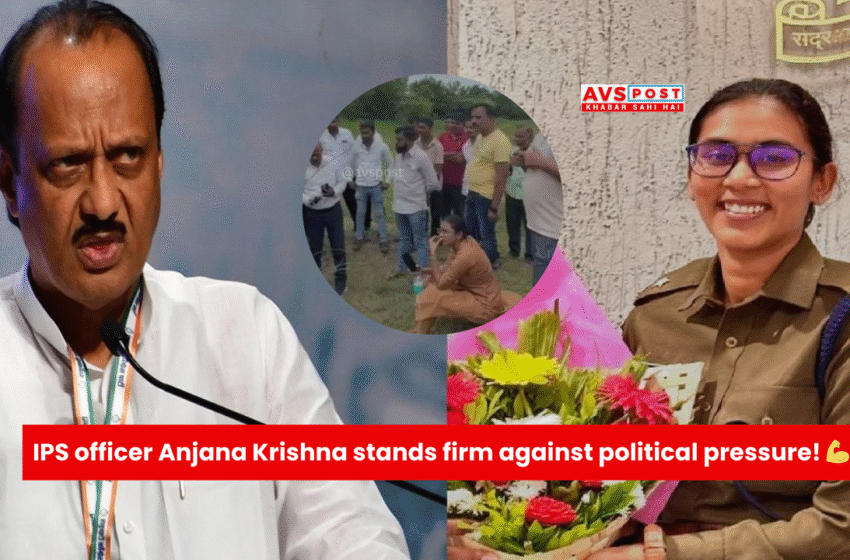
In a recent incident that has sparked widespread debate, IPS officer Anjana Krishna, a Sub-Divisional Police Officer (SDPO) in Solapur, Maharashtra, found herself at the center of a controversy involving Maharashtra Deputy Chief Minister and Nationalist Congress Party (NCP) leader Ajit Pawar. A viral video allegedly showing Pawar pressuring Krishna to halt action against illegal murrum excavation in Kurdu village has brought the issue of political interference in law enforcement into sharp focus. This blog delves into the incident, explores Anjana Krishna’s role, and examines the broader implications for law enforcement and governance in Maharashtra.

The Incident: A Clash of Duty and Power
Two days ago, IPS officer Anjana Krishna was leading an operation in Kurdu village, Solapur, targeting illegal murrum excavation—a material critical for road construction but often extracted unlawfully, causing environmental and economic harm. Acting on local complaints, Krishna’s team was cracking down on this illegal activity when she received a call, allegedly from Ajit Pawar. In the now-viral video, Pawar is heard saying, “Itna daring hua hai kya?” (Have you become so daring?) after Krishna reportedly asked him to contact her directly rather than through an intermediary’s phone.
This remark, perceived by many as condescending or intimidating, has ignited a firestorm of criticism. It raises questions about the extent to which political leaders exert influence over law enforcement officers who are simply doing their jobs. Krishna’s response, maintaining her professionalism in the face of such pressure, underscores her commitment to upholding the law, making her a focal point in this unfolding controversy.
Who is IPS Officer Anjana Krishna?
While little is publicly known about IPS officer Anjana Krishna personal background due to the limited information available, her actions in this incident paint a picture of a determined and principled officer. As an SDPO, Krishna is responsible for maintaining law and order in her jurisdiction, a role that often involves navigating complex social and political dynamics. Her decision to act on complaints of illegal murrum excavation demonstrates her dedication to addressing issues that affect local communities and the environment. Facing pressure from a senior political figure like Ajit Pawar, Krishna’s reported composure highlights the resilience required of IPS officers in such high-stakes situations.

The Larger Context: Illegal Mining in Maharashtra
Illegal murrum and sand mining have long plagued Maharashtra, driven by the high demand for construction materials and often shielded by powerful political and economic interests. Kurdu village is just one of many sites where such activities thrive, often with tacit support from local power structures. Reports from the Ministry of Mines and state investigations have repeatedly flagged unregulated mining as a major issue, with environmental degradation, loss of public revenue, and community displacement as consequences. IPS officer Anjana Krishna’s intervention in Kurdu village was a direct challenge to this entrenched system, making her a target for political pushback.
Political Interference or Systemic Failure?
The incident involving IPS officer Anjana Krishna brings two critical issues to the forefront:
- Political Interference in Law Enforcement: Ajit Pawar’s alleged attempt to influence Krishna’s actions suggests a troubling trend where political leaders feel emboldened to intervene in lawful operations. The phrase “Itna daring hua hai kya?” carries an undertone of authority that many interpret as an attempt to undermine an officer’s autonomy. This is particularly concerning in a state like Maharashtra, where political patronage in sectors like mining is well-documented. The defense offered by NCP leaders Sunil Tatkare and Revenue Minister Chandrashekhar Bawankule, who claimed Pawar’s tone was “normal,” has done little to quell public outrage, as the video speaks for itself.
- Challenges Faced by Law Enforcement: Krishna’s actions show that law enforcement officers are willing to take on illegal activities, even in the face of significant risks. However, incidents like this expose the vulnerabilities officers face when their decisions are challenged by powerful figures. The pressure exerted on Krishna could deter other officers from acting decisively in similar situations, potentially weakening the rule of law. This incident underscores the need for institutional mechanisms to protect officers from such interference and ensure they can perform their duties without fear of reprisal.

Public Reaction and the Role of Social Media
The viral nature of the video has amplified public awareness of this issue. Social media platforms, including X, have been abuzz with discussions about IPS officer Anjana Krishna’s courage and the audacity of political interference. Many netizens have praised Krishna for standing her ground, while others have criticized Pawar for what they see as an abuse of power. This incident has also reignited debates about the need for transparency and accountability in governance, with calls for stricter measures to curb political overreach.
Implications for Maharashtra’s Governance
The controversy surrounding IPS officer Anjana Krishna has far-reaching implications:
- Erosion of Public Trust: When senior leaders are seen pressuring law enforcement, it undermines public confidence in both the government and the police. Citizens may begin to question whether the system prioritizes justice or political interests.
- Need for Institutional Reforms: This incident highlights the urgent need for reforms to shield law enforcement from political influence. Independent oversight bodies, stricter anti-corruption laws, and clear protocols for handling such interactions could empower officers like Krishna to work without fear.
- Empowering Officers: Krishna’s stand is a reminder of the importance of supporting law enforcement officers who uphold the law against powerful interests. Recognizing and protecting such officers is crucial for maintaining the integrity of the system.
IPS officer Anjana Krishna’s confrontation with political pressure in Kurdu village is more than just a single incident—it’s a window into the challenges faced by law enforcement in Maharashtra. Her courage in addressing illegal murrum excavation, despite alleged interference from a figure as influential as Ajit Pawar, is a testament to the dedication of officers who strive to uphold justice. However, this episode also exposes the systemic issues that allow such interference to occur in the first place.
Also Read This : Inspector Zende Review : A Gripping Tale of Justice and Intrigue
IPS officer Anjana Krishna : To move forward, Maharashtra needs stronger safeguards to protect its officers and ensure that political power does not override the rule of law. Whether through stricter laws, independent oversight, or a cultural shift in governance, the goal must be to create an environment where officers like Anjana Krishna can perform their duties without fear or favor. What are your thoughts on this issue? Should the focus be on punishing political interference, or is a broader overhaul of the system needed? Share your views below.