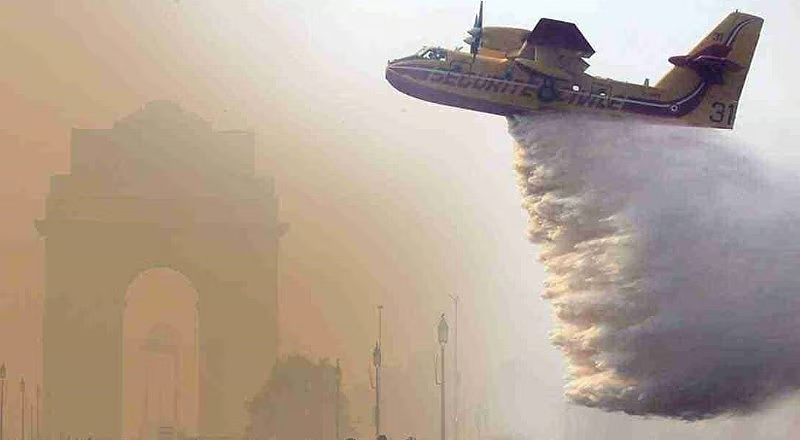
Tag: Delhi AQI.

  • Artificial Rain : Delhi’s Daring Experiment to Combat Deadly Smog

    Artificial Rain : Delhi’s Daring Experiment to Combat Deadly Smog

    Artificial Rain : Delhi’s air quality index (AQI) has plummeted to hazardous levels post-Diwali, with fine particulate matter (PM2.5) choking the lungs of millions. Enter artificial rain—a weather modification technique known as cloud seeding—that promises to literally wash away the pollution. But is this high-tech hail Mary a real game-changer, or just another drop in the polluted ocean?

    In this blog, we’ll dive into what artificial rain is, how Delhi is gearing up for its first trial, the science behind it, and why it’s sparking both hope and skepticism worldwide.

    What Exactly is Artificial Rain?

    Artificial rain, or cloud seeding, isn’t some sci-fi plot—it’s a proven meteorological hack that’s been around since the 1940s. The core idea? Humans playing rainmaker by injecting clouds with particles that encourage water droplets to form and fall as precipitation.
    Artificial Rain
    Artificial Rain

    Here’s the simple science :-

    • Target Clouds : Pilots scan for supercooled clouds (those below freezing but still liquid) using radar and weather data.
    • Seeding Agents : From an aircraft or ground-based generators, they release substances like silver iodide (which mimics ice crystals), dry ice (solid CO2), or even table salt. These act as “nuclei” for moisture to cling to.
    • The Cascade Effect : Tiny droplets collide and grow into raindrops heavy enough to plummet to earth.

    The goal isn’t to conjure rain from thin air but to amplify what’s already brewing in the atmosphere. Success rates? Studies suggest 10-30% more precipitation in ideal conditions, though measuring exact impact remains tricky—how do you prove what wouldn’t have rained without intervention?

    Globally, it’s no stranger: China deploys it for drought relief and even cleared Beijing’s skies for the 2008 Olympics. The UAE uses it to green deserts, while the U.S. has seeded clouds for over 50 years to boost snowfall in ski resorts.

    Delhi’s Smog Crisis : Why Artificial Rain Now?

    Delhi isn’t just polluted—it’s the world’s most polluted city, according to recent IQAir rankings. Post-Diwali fireworks, crop burning from neighboring states, and stagnant winter winds have pushed AQI above 400 in parts of the National Capital Region (NCR). That’s “severe” territory, where kids stay home, construction halts, and hospitals overflow with respiratory cases.

    Enter the Delhi government’s bold move: artificial rain as an emergency detox. On October 23, 2025, a successful trial flight over Burari released seeding agents into clouds, confirming the tech’s viability. Chief Minister Rekha Gupta announced that if weather gods cooperate—with cloudy skies forecast for October 28-30—the capital could see its first man-made downpour on October 29.

    “This is a necessity,” Gupta stated, emphasizing how the rain would scrub PM2.5 and PM10 particles from the air, potentially slashing AQI by 20-30%. The operation, costing around ₹50 lakh per flight, involves IIT Kanpur experts and aircraft from the Indian Air Force. It’s not just about today—future plans include regular seeding during peak pollution months.

    Social media is buzzing. On X (formerly Twitter), users like @IndianTechGuide hailed it as a “tech triumph,” while farmers voiced concerns about untimely rains damaging fresh wheat crops. Vision IAS shared a video breakdown, questioning if cloud seeding can truly “clear the air” long-term.

    The Promise and Perils of Cloud Seeding

    The Upsides

    • Instant Relief : A single shower can trap pollutants in raindrops, depositing them on the ground for cleanup. In past UAE trials, it reduced urban dust by up to 40%.
    • Multi-Purpose : Beyond pollution, it aids agriculture in drought-hit areas and stabilizes reservoirs for hydropower.
    • Eco-Friendly Edge : Compared to chemical foggers or water sprinklers, it’s targeted and uses minimal agents.
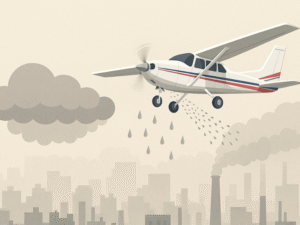
    Artificial Rain
    Artificial Rain

    The Challenges

    • Weather Lottery : No clouds, no rain. If October 29 stays dry, it’s back to square one.
    • Unproven in Urban Chaos : Delhi’s mega-pollution soup might overwhelm the washout—experts warn it could redistribute toxins rather than eliminate them.
    • Environmental Risks : Silver iodide is low-toxicity, but overuse raises questions about soil and water contamination. Plus, who gets the rain? Downwind areas might flood while upstream stays parched.
    • Cost vs. Cure : At ₹50 lakh a pop, it’s pricey. Critics argue it’s a band-aid when root fixes—like stricter stubble burning bans or electric vehicle mandates—lag behind.

    A Guardian report captured the skepticism: “India trials Delhi cloud seeding to clean air in world’s most polluted city,” but experts like those at Context News note it’s no silver bullet for the “airpocalypse.”

    Aspect Potential Impact in Delhi Global Precedent
    Pollution Reduction 20-30% AQI drop per event UAE: 40% dust cut
    Cost ₹50 lakh/flight China: $100M/year program
    Success Rate 50-70% (weather-dependent) U.S.: 10-15% precip boost
    Risks Chemical residue, uneven rain Minimal, but monitoring needed

    A Global Lifeline or Local Gimmick?

    Artificial rain shines brightest in water-scarce spots. Australia’s “Rainmaker” project revived farms during the Millennium Drought, while California’s seeding fights wildfires by enhancing snowpack. In India, Maharashtra and Tamil Nadu have toyed with it for monsoons, but Delhi’s urban twist makes it pioneering.

    Yet, as NDTV’s aerial report from the trial plane reveals, the real test is integration: Pair seeding with GRAP (Graded Response Action Plan) stages, green corridors, and public transport pushes. Without that, it’s like mopping the floor during a flood.

    Also Read This : Mappls : India’s Indigenous Navigation Revolution Developed by Indian Company MapmyIndia

    Clearing the Air : What’s Next for Delhi?

    As October 29 approaches, all eyes are on the skies. Will artificial rain deliver a breath of fresh air to 30 million Delhiites? Early signs are promising—the Burari trial showed chemical dispersion without a hitch. But true victory lies in prevention: Reforestation, clean energy, and cross-state cooperation.
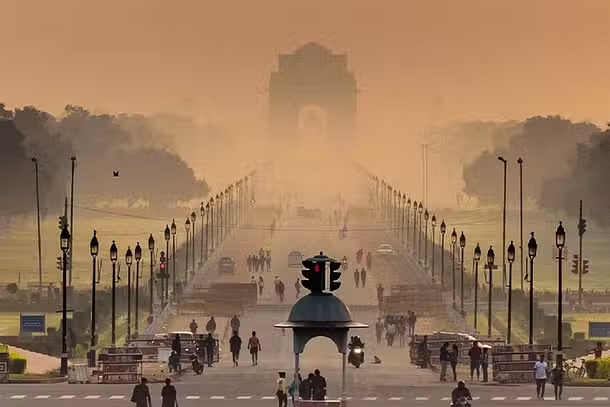
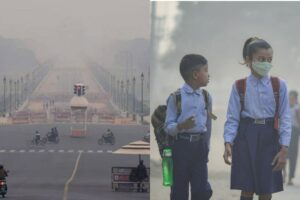
  • Delhi air pollution: Action of government, physical classes of students suspended, police officials statement.

    Delhi air pollution: Action of government, physical classes of students suspended, police officials statement.

    Delhi air pollution: The AQI in Delhi again seems to drop after the report which came this Tuesday, which shows records of the AQI drop by 471. All in all Delhi is not at a great start before the winters.

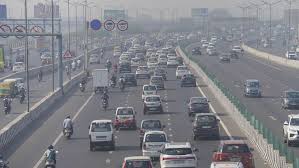
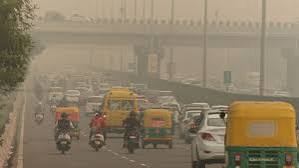
    This record set Delhi on High alert as the national capital came under the ‘serve plus’ category for two days straight. Delhi also seems to have a smog level and layer increase which has lowered the visibility.

    What is GRAP?

    The Graded Response Action Plan (GRAP) is an emergency measure applied by the Delhi government to maintain the air quality of capital.

    How will GRAP help in maintaining pollution?

    Under the stage 3 and 4 of GRAP plan the government has done the following: –

    1. Suspension of physical classes in school and colleges.
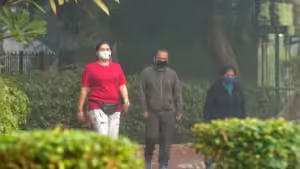
    2. Advice on wearing a Mask for prevention.
    3. Some office is also closed under the plan.
    4. Restriction of vehicles in Delhi until its LNG, CNG or electric. Petrol or diesel vehicles are fully prohibited.
    5. Apart from this construction activities are also banned.

    CM Atishi Marlena on Delhi air pollution.

    She said and pointed out the farmers of Haryana and Punjab for pollution and immersion of harmful gases by their farm activities. She further also pointed out that they have been warned several times but no action has been taken against them.

    She also claimed BJP’S poor politics is one reason behind bad AQI and also Yamuna river pollution. She said they are not taking any action in Haryana and Punjab which is leading to heavy pollution in Delhi.

    Delhi air pollution
    Delhi air pollution

    Delhi police on High AQI.

    They are taking many proactive measures. This could include:-

    1. Checking of vehicles after the banning of petrol and diesel vehicles.
    2. Taking challans and fines on prohibition or violation of the law.
    3. Controlling of heavy traffics.
    4. Collaborating and working with MCD and other government stakeholders.
    5. Using drones and other devices to measure.
    6. Starting of new campaign
    7. They are also working with other RWs 9 (Resident Welfare Associations).
    8. They are also monitoring green drive services.
    9. They are also controlling special task forces to control pollution.
    10. Coordination with NCR or neighbouring state.

    Also Read This: Understanding the Air Quality Index (AQI): What it means and why it’s important

    Pollution effects on human health and body.

    1. This air and pollution is not good for the human body, it could lead to several lungs and respiratory problems.
    2. It could also lead to headaches, nasal congestion, and skin diseases and other serious conditions.
    3. It could also cause cancer and heart problems.
    4. It also increases the risk of pneumonia.
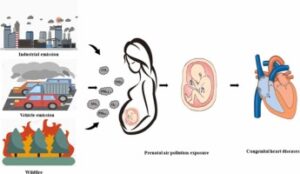
    5. This is not an ideal AQI of pregnant women or new born kids.
    6. It could also lead to faster skin aging and etc.
    7. Old people are also at high health risk due to pollution.
    8. It could also lead to skin problems like dermatitis, eczema or other.
    9. It cause irritation in eyes, nose and throat too.
    10. It is also a major cause of chronic obstructive pulmonary disease.
    This is not an ideal AQI of pregnant women or new born kids
    This is not an ideal AQI of pregnant women or new born kids

    What measure can we take to control Delhi air pollution?

    1. Wear masks to avoid inhaling too much bad air.
    2. Use an air purifier.
    3. By doing car-pulling
    4. Using more public transport.
    5. Reduce emissions from house.
    6. Use alternative fuels like CNG and etc and by avoiding petrol or diesel.
    7. Use of eco-friendly product.
    8. Plant more and more trees.
    9. Rising awareness.
    10. Organising community clean up.
    Wear masks to avoid inhaling too much bad air
    Wear masks to avoid inhaling too much bad air

    Also Read This: Delhi pollution: thin layers of smog, AQI drop, NCR reports and more.

    Report By: Enakshi Dasgupta 

  • Delhi pollution: thin layers of smog, AQI drop, NCR reports and more.

    Delhi pollution: thin layers of smog, AQI drop, NCR reports and more.

    Delhi pollution: On the morning of November 1, 2024 after a major Diwali celebration, Delhi suffered from a major air quality index (AQI) drop of 360, people woke up to thin layer of smog.

    Condition of Delhi and other places.

    With such air quality drop Delhi NCR areas like Noida, Gurgaon and Ghaziabad also suffers. Apart from these Delhi neighbouring states like Haryana, Punjab, Uttar Pradesh and Chandigarh also suffer.

    Delhi pollution
    Delhi pollution

    Delhi comparison from past 3 years reports.

    According to report Delhi has little better AQI from past 3 years, in 2022 AQI drop for 374 and in 2021 AQI drop was 440. In further reports it is said that Delhi, Haryana and Uttar Pradesh were most polluted states on Diwali between 2019 and 2023, and so as this year.

    Cause of AQI drop in Delhi.

    The major cause of AQI drop is violation of rules set by government for pollution control. There was also a major ban on firecrackers but people seem to ignore it all which led too a major AQI drop. Apart from this stubble burning in areas like Punjab and Haryana is also the reason for AQI drop in Delhi and NCR area. The report revealed that Diwali is the reasons for pollution level increase but only for 24 hours after which pollution level normalised.

    Delhi government efforts to maintain pollution and AQI control.

    The Delhi government failed to reduce pollution despite several efforts and rules. There were more than 377 teams hired to enforce these rules across Delhi.

    Delhi pollution
    Delhi pollution

    Gopal Rai on Delhi AQI.

    Delhi Environment Minister Gopal Rai says that, “Delhi air quality has been in “very poor” category for the past few days. People had predicted that there would be rise in level of air pollution in Delhi on next days of Diwali, but we can see it the pollution level has remained under control”.

    DPCC after AQI drop in Delhi.

    Delhi pollution control committee (DPCC) imposed a total ban on firecracker until January 1, 2025 to control AQI of Delhi and NCR areas. There will be on sale, manufacturing, storage and usage of firecrackers in the process of banning.

    Also Read This: DELHI POLLUTION: AUI DROP, AAP BEING BLAMED, SUPREME COURT STATEMENT, HARYANA AND PUNBJAB AUTOMOBILE POLLUTION.

    They have also predicted in there forecast that Delhi could face peak pollution from November 1 to 15. In considering to this point government started to increase water sprinkling in Delhi to control air pollution.

    Report By: Enakshi Dasgupta