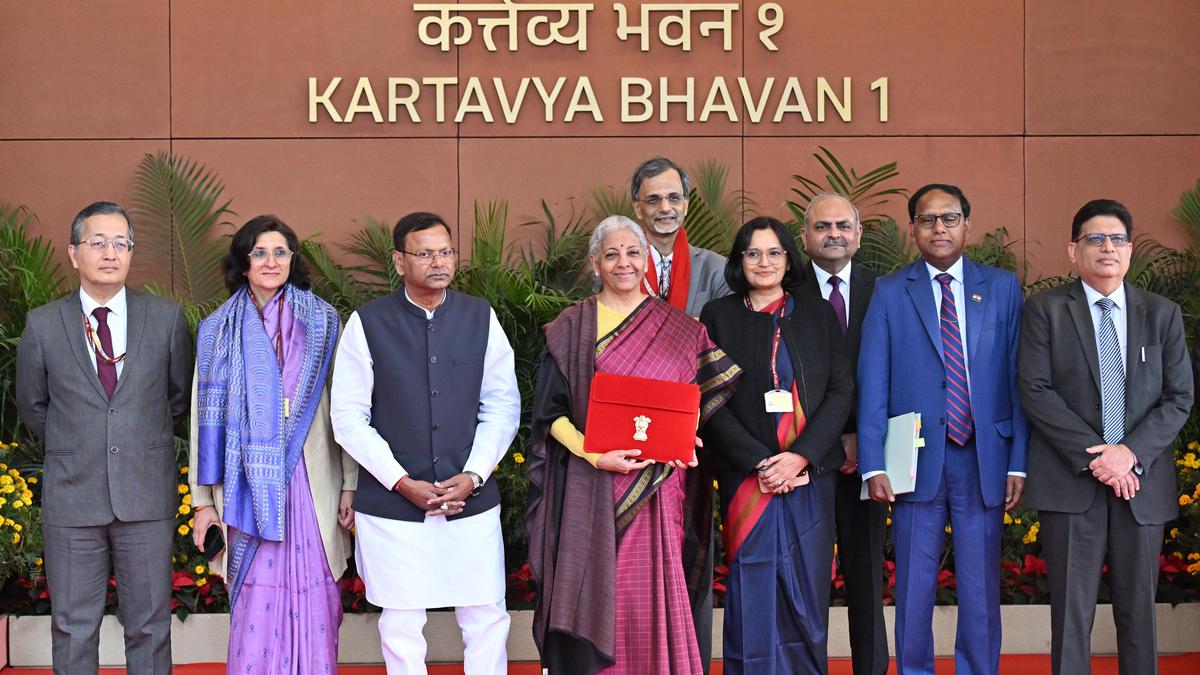
Union Budget 2026 highlights : The Union Budget 2026-27, presented by Finance Minister Nirmala Sitharaman on February 1, 2026, marks her ninth consecutive budget speech. Tabled in Parliament on a Sunday for the first time in India’s history, this “Yuva Shakti-driven” budget emphasizes the government’s commitment to the poor, underprivileged, and disadvantaged. It draws inspiration from three core Kartavyas (duties):
- Accelerate and sustain economic growth by boosting productivity, competitiveness, and resilience amid global volatility.
- Fulfill people’s aspirations and build their capacities to make them strong partners in India’s prosperity.
- Align with the vision of Sabka Saath, Sabka Vikas — ensuring every family, community, region, and sector has access to resources, amenities, and opportunities.
Described as a budget of “reforms over rhetoric” and “action over ambivalence,” it prioritizes structural reforms, fiscal discipline, moderate inflation, sustained ~7% growth, and continued public investment to advance toward Viksit Bharat (Developed India).
View this post on Instagram
Fiscal Framework : Prudence Meets Momentum
The budget 2026 maintains a strong focus on capital expenditure while progressing toward fiscal consolidation.
- Public Capital Expenditure (Capex): Raised to ₹12.2 lakh crore (approximately 4.4% of GDP) — the highest-ever allocation — up from ₹11.2 lakh crore in BE 2025-26, to sustain infrastructure momentum and crowd in private investment.
- Fiscal Deficit: Targeted at 4.3% of GDP for FY 2026-27 (down from 4.4% in RE 2025-26).
- Debt-to-GDP Ratio: Projected at 55.6% in BE 2026-27 (from 56.1% in RE 2025-26), with a long-term goal of 50 ± 1% by 2030.
- Total Budget Size: Approximately ₹53.5 lakh crore.
- Non-Debt Receipts and Total Expenditure: Estimated at ₹36.5 lakh crore and ₹53.5 lakh crore, respectively.
- Net Tax Receipts: Around ₹28.7 lakh crore.
These parameters reflect continued fiscal prudence while prioritizing growth-enabling investments.
Budget 2026 : Manufacturing, Infrastructure, and Beyond
Budget 2026 : Under the first Kartavya, the budget proposes interventions in six major areas:
- Scaling Up Manufacturing in 7 strategic and frontier sectors.
- Rejuvenating Legacy Industrial Sectors.
- Creating Champion MSMEs — including a ₹10,000 crore SME Growth Fund.
- Powerful Push to Infrastructure.
- Long-Term Energy Security and reduced critical import dependencies.
- Developing City Economic Regions (CERs).
View this post on Instagram
Notable announcements include:
- Biopharma Shakti: ₹10,000 crore over 5 years for domestic biologics and biosimilars production.
- India Semiconductor Mission (ISM) 2.0: Launch to strengthen equipment, materials, design, and supply chains.
- Electronics Components Manufacturing Scheme: Outlay increased to ₹40,000 crore.
- Rare Earth Corridors: Support in states like Odisha, Kerala, Andhra Pradesh, and Tamil Nadu.
- Infrastructure Highlights:
- 7 high-speed rail corridors (e.g., Mumbai-Pune, Pune-Hyderabad, Hyderabad-Bengaluru, Hyderabad-Chennai, Chennai-Bengaluru, Delhi-Varanasi, Varanasi-Siliguri).
- New dedicated freight corridors (including east-west).
- Operationalization of 20 new National Waterways over 5 years.
- Seaplane Viability Gap Funding (VGF) to boost indigenous manufacturing.
- Infrastructure Risk Guarantee Fund for private developers.
- City Economic Regions: ₹5,000 crore per CER over 5 years.
- Defence: Record allocation (all-time high of around ₹7.85 lakh crore, up ~15%; capex hiked significantly, e.g., ~21% in some reports to ₹5.9 lakh crore).
- Other Sectors:
- Tourism: Upskilling 10,000 guides; reduced TCS on overseas tours; development of 15 archaeological sites; first Global Big Cat Summit; Khelo India Mission for sports skilling and employment.
- AVGC (Animation, Visual Effects, Gaming, Comics — Orange Economy): AVGC Content Creator Labs in 15,000 schools and 500 colleges.
- Agriculture: Dhan-Dhaanya Krishi Yojana for high-yield crops; Bharat-Vistaar AI tool.
- Textiles: Integrated programme with mega parks and export support.
View this post on Instagram
Tax and Customs Reforms : Simplification and Relief
Budget 2026 : No changes to income tax slabs were announced, continuing stability from prior budgets. Key updates include:
- New Income Tax Act, 2025: Effective from April 1, 2026, with simplified rules.
- Middle-Class Reliefs: TCS cuts, new dividend deductions, nil deduction certificates for small taxpayers, ITR filing extension to August 31 for non-audit cases, rationalized penalties/prosecutions, and provident fund rule updates.
- Securities Transaction Tax (STT): Increased on futures (e.g., to 0.05% from 0.02%).
- Customs Duties:
- Reduced from 20% to 10% on personal imports.
- Exemptions/reductions on capital goods for lithium-ion cells, critical minerals, cancer medicines, sports equipment, leather goods, and seafood.
- Some items (imported alcohol, coffee) may become costlier.
- Other: Tax holidays for foreign cloud providers till 2047; MAT reforms; safe harbour enhancements for IT services; buyback taxed as capital gains.
Overall Assessment
The Union Budget 2026 – 27 is a continuity-focused, producer-centric document that doubles down on capex-led growth, manufacturing self-reliance, infrastructure, and inclusive reforms rather than short-term populist measures. It aims to build resilience against global uncertainties while empowering youth, MSMEs, and underserved sections.