Tag: AI

  • AI Transformation : IndiaAI’s Second Report, Shaping the Future of Jobs, Skills, and AI Infrastructure

    AI Transformation : IndiaAI’s Second Report, Shaping the Future of Jobs, Skills, and AI Infrastructure

    AI Transformation : India is rapidly positioning itself as a global leader in artificial intelligence (AI), driven by its dynamic tech ecosystem, growing digital infrastructure, and forward-thinking government initiatives. The IndiaAI Mission’s second report highlights AI’s transformative impact on the job market, skill requirements, and infrastructure development. This blog dives into the report’s key insights, exploring how AI is reshaping employment, redefining skills, and strengthening India’s AI infrastructure to fuel innovation and economic growth.

    The AI-Driven Job Market: Opportunities and Challenges

    The IndiaAI Mission’s second report underscores AI’s dual role in India’s economy: creating new job opportunities while necessitating workforce adaptation to address automation-related challenges. AI is expected to significantly contribute to India’s economy, potentially adding $957 billion by 2035 and creating over 1 million AI-related jobs by 2026 across sectors like IT, healthcare, finance, and manufacturing.
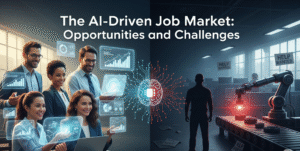
    AI Transformation : The AI-Driven Job Market: Opportunities and Challenges
    AI Transformation : The AI-Driven Job Market: Opportunities and Challenges

    Emerging Job Roles

    AI Transformation is driving demand for specialized, high-skill roles that blend technical expertise with domain knowledge. Key roles include:

    • AI Architects: Designing scalable AI systems for enterprise use.
    • Machine Learning Engineers: Developing and deploying predictive models.
    • AI Ethics Officers: Ensuring responsible and unbiased AI applications.
    • Natural Language Processing (NLP) Specialists: Creating language models tailored to India’s multilingual landscape.
    • AI Healthcare Consultants: Applying AI for diagnostics and personalized care.

    The report notes a 46% year-on-year surge in demand for Machine Learning Engineers and a 23% increase for Full Stack AI Scientists, reflecting a shift toward specialized, interdisciplinary roles. AI is also enhancing productivity in sectors like finance and logistics, creating opportunities for professionals skilled in AI-driven data analysis and optimization.

    Addressing Job Displacement

    AI Transformation : While AI promises job creation, it also poses risks of job displacement, particularly in repetitive, low-skilled roles. Studies estimate that up to 30% of jobs in manufacturing, retail, and administrative sectors could be automated by 2030, with 24% of tasks across industries potentially fully automated. This could free up significant time for workers but requires a transition to new roles.

    To counter this, the report emphasizes reskilling and upskilling to prepare the workforce for AI-driven roles. With 61% of Indian employees expressing concerns about automation—higher than the global average of 44%—there is an urgent need to align workforce capabilities with emerging demands.

    AI Transformation : AI Healthcare Consultants: Applying AI for diagnostics and personalized care.
    AI Transformation : AI Healthcare Consultants: Applying AI for diagnostics and personalized care.

    The Skills Imperative: Preparing an AI-Ready Workforce

    AI Transformation : The report highlights that technical expertise alone is not enough for success in the AI-driven economy. Alongside technical skills, soft skills like problem-solving, creativity, emotional intelligence, and interdisciplinary knowledge are increasingly critical for roles such as AI product managers and ethicists.

    Strategies for Skill Development

    To address the skills gap, the report outlines several strategies:

    1. Industry-Academia Partnerships: Collaborations to create AI-focused curricula that meet market demands, particularly in fields like semiconductors.
    2. Reskilling Programs: Large-scale initiatives to transition workers from declining roles to AI-driven ones, with 81% of Indian employers planning to support employees in adapting to AI technologies.
    3. Focus on Non-Metro Areas: Expanding AI education and training to Tier-2 and Tier-3 cities to access diverse talent pools.
    4. AI Ethics Training: Promoting responsible AI use to address ethical and regulatory challenges, especially as 44% of Indians rely on AI chatbots for news, raising concerns about misinformation.
    5. Inclusive Hiring Practices: 67% of Indian employers are adopting skills-based hiring, such as removing degree requirements, to tap into diverse talent.

    India’s leadership in AI skill penetration, with tech talent three times more likely to report AI skills than in other countries, positions it as a global hub. However, scaling training programs to cover more than the current 100,000 workers annually is critical to meet future demand.

    AI Transformation -The Skills Imperative: Preparing an AI-Ready Workforce
    AI Transformation -The Skills Imperative: Preparing an AI-Ready Workforce

    AI Infrastructure : The Foundation of India’s AI Ambitions

    The IndiaAI Mission prioritizes robust AI infrastructure to support innovation and economic growth. Significant investments are being made to build compute capacity, data platforms, and digital ecosystems to drive AI development.

    Key Infrastructure Initiatives

    1. Compute Capacity: The mission aims to address the projected need for 30,000 GPUs by 2027 to support AI model development and deployment.
    2. IndiaAI Datasets Platform: Set to launch in January 2025, this platform will provide access to public and private datasets to fuel AI innovation in sectors like healthcare, education, and agriculture.
    3. Digital Public Infrastructure (DPI): Systems like Aadhaar, UPI, and DigiLocker enable AI applications such as fraud detection and personalized services, leveraging India’s 700 million smartphone users and low data costs.
    4. Support for Startups: The mission supports India’s 10,000+ AI-focused startups, including platforms offering localized generative AI solutions in multiple Indian languages.

    AI Transformation : Infrastructure Challenges

    AI Transformation : Despite these efforts, challenges remain:

    • Siloed Data: Large amounts of data from India’s DPI are underutilized or inaccessible, limiting AI model development.
    • Overreliance on Government: The strategy heavily depends on public funding, which may constrain scalability without increased private-sector involvement.
    • Compute Shortages: Meeting the demand for high-performance computing infrastructure requires significant investment and global partnerships.
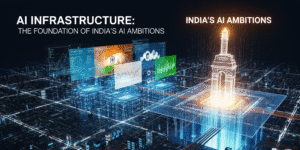
    AI Infrastructure: The Foundation of India’s AI Ambitions
    AI Infrastructure: The Foundation of India’s AI Ambitions

    A Vision for an AI-Powered India

    The IndiaAI Mission’s second report paints an optimistic yet pragmatic picture of India’s AI future. By fostering job creation, prioritizing skill development, and investing in robust infrastructure, India is laying the groundwork to become a global AI powerhouse. However, addressing challenges like job displacement, skills gaps, and data accessibility will be critical to sustaining this momentum.

    Also Read This : How to Repost Instagram Reels Effectively : A Comprehensive Guide

    AI Transformation : As India embraces AI Transformation potential, collaboration between government, industry, and academia will be key to ensuring inclusive growth. By equipping its workforce with the right skills and building cutting-edge infrastructure, India can harness AI to drive economic prosperity and innovation for years to come.


  • Mastering Prompt Engineering : Unlocking the Power of AI in 2025

    Mastering Prompt Engineering : Unlocking the Power of AI in 2025

    In the rapidly evolving world of artificial intelligence, prompt engineering has emerged as a critical skill for maximizing the potential of large language models (LLMs) like Grok 3, ChatGPT, and other generative AI tools. By crafting precise and context-rich prompts, professionals can guide AI to deliver accurate, relevant, and high-quality outputs for tasks ranging from content creation to complex problem-solving. This blog explores what prompt engineering is, why it matters, and how to excel in this in-demand field as of July 2025.

    What is Prompt Engineering?

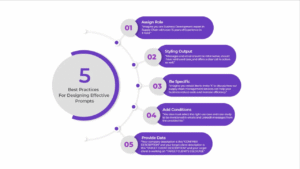
    Prompt engineering is the art and science of designing text-based instructions (prompts) to elicit desired responses from AI models. Whether you’re generating a blog post, coding a script, or analyzing data, well-crafted prompts ensure the AI understands your intent. For example, instead of asking, “Write a story,” a skilled prompt engineer might say, “Write a 500-word sci-fi story set in 2150 about an astronaut discovering alien ruins, using a suspenseful tone.”

    Prompt Engineering
    Prompt Engineering

    Why It Matters

    • Precision: Effective prompts reduce ambiguity, improving AI output quality.
    • Efficiency: Clear instructions save time by minimizing iterative refinements.
    • Versatility: Applicable across industries like marketing, healthcare, and software development.
    • Security: Well-designed prompts mitigate risks like prompt injection attacks, where malicious inputs manipulate AI behavior.

    Key Techniques in Prompt Engineering

    To master prompt engineering, understanding core techniques is essential. Here are some widely used methods:

    1. Zero-Shot Prompting: Direct instructions without examples (e.g., “Summarize this article in 100 words”).
    2. Few-Shot Prompting: Providing examples to guide the AI (e.g., “Here are two professional emails. Write one in the same style”).
    3. Chain-of-Thought (CoT) Prompting: Encouraging step-by-step reasoning (e.g., “Solve this math problem and explain each step”).
    4. Role Assignment: Assigning a persona to the AI (e.g., “Act as a financial advisor and recommend investment options”).
    5. Contextualization: Adding relevant details (e.g., “Given a $500 budget, suggest a gaming laptop”).

    These techniques, when combined with natural language processing (NLP) principles, enable precise control over AI outputs.

    Skills for Aspiring Prompt Engineers

    Becoming a proficient prompt engineer requires a blend of technical and creative skills:

    • Linguistic Expertise: Strong grasp of language structure, semantics, and tone.
    • AI Knowledge: Familiarity with LLM architectures (e.g., transformers) and their limitations.
    • Analytical Thinking: Ability to analyze outputs and refine prompts iteratively.
    • Domain Knowledge: Expertise in fields like marketing, law, or tech to tailor prompts effectively.
    • Programming (Optional): Basic skills in Python or JavaScript for integrating prompts into applications.
    Prompt Engineering
    Prompt Engineering

    Real-World Applications

    Prompt engineering powers diverse AI applications:

    • Content Creation: Generating blog posts, ad copy, or social media content.
    • Customer Support: Building chatbots with natural, helpful responses.
    • Software Development: Writing code snippets or debugging with AI assistance.
    • Data Analysis: Summarizing reports or extracting insights from datasets.
    • Education: Creating personalized learning materials or tutoring systems.

    For example, a prompt engineer might design: “You are a marketing expert. Write a 200-word email promoting a $199 smartwatch with a 7-day battery life, targeting fitness enthusiasts aged 25-40, with a persuasive tone and a pre-order CTA.”

    The Future of Prompt Engineering

    As AI evolves, prompt engineering is shifting toward context engineering, focusing on managing broader datasets and complex interactions. Tools like Snorkel and Playground AI are streamlining prompt creation, while automatic prompt generation using LLMs is gaining traction. However, the demand for skilled prompt engineers remains strong, with salaries ranging from $100,000 to $300,000 annually, reflecting the role’s value in industries adopting AI.

    How to Get Started

    1. Learn the Basics: Explore free resources or courses like Vanderbilt’s Prompt Engineering Specialization on Coursera.
    2. Practice: Experiment with platforms like grok.com or x.com, where you can access Grok 3 for free (with usage quotas).
    3. Join Communities: Engage with AI communities on platforms like X to stay updated on trends.
    4. Build a Portfolio: Showcase your prompts and their outputs to demonstrate expertise.
    Prompt Engineering
    Prompt Engineering

    For advanced use, consider xAI’s SuperGrok subscription for higher usage quotas (details at https://x.ai/grok) or explore their API services for custom applications (https://x.ai/api).

    Also Read This : Avatar Movie Trailer Breakdown: Stunning Visuals, Emotional Story & Why Fans Are Excited for James Cameron’s Next Epic

    Prompt engineering is a gateway to unlocking AI’s full potential, blending creativity, technical skill, and strategic thinking. By mastering techniques like few-shot prompting, chain-of-thought, and contextualization, you can shape AI outputs to meet diverse needs. As AI continues to transform industries in 2025, prompt engineers will play a pivotal role in driving innovation. Start experimenting today, and harness the power of AI prompting to create impactful solutions.

  • AtCoder World Tour Finals 2025 : Humanity Triumphs Over AI

    AtCoder World Tour Finals 2025 : Humanity Triumphs Over AI

    AtCoder World Tour Finals 2025

    On July 20, 2025, the coding world witnessed an electrifying showdown at the AtCoder World Tour Finals 2025 in Tokyo, Japan. In a historic “Humans vs AI” heuristic competition, Polish programmer Przemysław Dębiak (Psyho) emerged victorious, defeating OpenAI’s custom AI model in a grueling 10-hour coding marathon. This blog dives into the details of this remarkable event, highlighting the triumph of human ingenuity over artificial intelligence.

    AtCoder World Tour Finals 2025
    AtCoder World Tour Finals 2025

    The Battle: Humans vs AI

    The AtCoder World Tour Finals 2025 was no ordinary programming contest. Designed to test the limits of both human and machine intelligence, the competition focused on NP-hard optimization problems—complex challenges that demand not just technical prowess but also creative problem-solving. The stage was set for a thrilling clash between Przemysław Dębiak, a former OpenAI employee and seasoned competitive programmer, and OpenAI’s state-of-the-art AI model, tailored for high-performance coding.

    The contest spanned 10 intense hours, pushing participants to their limits. Dębiak, operating on minimal sleep, showcased the resilience and adaptability that define human competitors. His opponent, OpenAI’s AI, brought unparalleled computational speed and precision to the table, making this a true test of human intuition versus machine efficiency.

    AtCoder World Tour Finals 2025
    AtCoder World Tour Finals 2025

    The Result: A Human Victory

    When the final scores were tallied, Dębiak clinched the championship with an impressive 1.81 trillion points, outperforming OpenAI’s AI by a significant 9.5% margin (1.65 trillion points). This victory was not just a personal triumph for Dębiak but a moment of pride for the global programming community. As he celebrated his win, Dębiak took to X, posting, “Humanity has prevailed (for now!)”—a nod to the ongoing rivalry between human coders and AI systems.

    Why This Matters

    The AtCoder World Tour Finals 2025 highlighted the unique strengths of human programmers. While AI excels at rapid computation and pattern recognition, Dębiak’s success underscored the power of human intuition, creativity, and strategic thinking. NP-hard problems often require unconventional approaches, and Dębiak’s ability to think outside the box gave him the edge over the AI’s algorithmic precision.

    This event also sparked discussions about the future of competitive programming. As AI continues to advance, contests like these serve as a benchmark for measuring human capabilities against machine intelligence. Dębiak’s victory is a reminder that, for now, humans can still hold their own in domains that demand both technical skill and creative insight.

    AtCoder World Tour Finals 2025
    AtCoder World Tour Finals 2025

    The Bigger Picture

    The “Humans vs AI” narrative at AtCoder 2025 resonates beyond the coding arena. It reflects the broader dialogue about the role of AI in our world. While AI tools like OpenAI’s model are transforming industries, human ingenuity remains a critical force in solving complex, open-ended problems. Dębiak’s win is a testament to the enduring value of human expertise, even in an age of rapid technological progress.

    Also Read This : Astronomer CEO Controversy: Coldplay Concert Sparks Speculation

    The AtCoder World Tour Finals 2025 will be remembered as a landmark event in competitive programming. Przemysław Dębiak’s triumph over OpenAI’s AI model is a celebration of human potential, proving that creativity and perseverance can still outshine even the most advanced algorithms. As the coding community looks ahead, one thing is clear: the battle between humans and AI is far from over, and events like these will continue to shape the future of technology.

  • ChatGPT Outage : What Happened and What’s Next?

    ChatGPT Outage : What Happened and What’s Next?

    ChatGpt Outage : On June 10, 2025, ChatGPT, one of the most widely used AI chatbots, faced a significant global outage that left users across North America, Europe, India, and Australia unable to access the service. Starting around 2:36 AM ET, reports flooded in about network errors, unresponsive chats, and error messages, impacting both free and ChatGPT Plus users. This disruption also affected OpenAI’s Sora and GPT API services, highlighting the interconnected nature of their infrastructure.

    ChatGpt Outage
    ChatGpt Outage

    What Caused the ChatGpt Outage?

    According to OpenAI’s official status page, the issue stemmed from elevated error rates and latency, with the root cause identified but not publicly detailed. By 7:51 PM IST, OpenAI was still working on a fix, with no clear timeline for full restoration. DownDetector reported a peak of over 1,000 user complaints around 5:30 AM ET, with India alone logging over 800 reports by 3 PM IST. The widespread downtime raised concerns about the reliability of AI-driven services, especially for businesses and developers relying on the GPT API.

    User Reactions and Impact

    The outage sparked a wave of reactions on platforms like X, where users expressed frustration, some humorously noting their dependence on AI for daily tasks. Others speculated about potential updates or server overloads. For ChatGPT Plus subscribers, the disruption was particularly inconvenient, as premium services promise higher reliability and uptime. Developers using the GPT API reported stalled projects, while Sora users faced delays in generating AI-driven content.

    ChatGpt Outage
    ChatGpt Outage

    This incident underscores the growing reliance on AI tools and the ripple effects when technology fails. Businesses, students, and casual users alike were reminded of the importance of backup systems and diversified workflows.

    Also Read This: Vijay Shankar : The Resilient All-Rounder of Indian Cricket

    What’s Next for ChatGPT?

    OpenAI’s team is actively addressing the issue, and while no official ETA has been shared, past outages suggest a resolution within hours to a day. Users are advised to avoid repeatedly refreshing sessions to prevent triggering security verifications, which could further delay access. For real-time updates, check OpenAI’s status page or platforms like X for user-driven insights.

  • Google I/O 2025 : Exploring the Future of AI and Android

    Google I/O 2025 : Exploring the Future of AI and Android

    Google I/O 2025 followed by a developer-focused keynote at 1:30 PM PT. The event, held at the Shoreline Amphitheatre and live streamed globally, promises two days of groundbreaking announcements, technical sessions, and hands-on demos. If you’re not in Mountain View, you can still catch the action on Google’s YouTube channel or the official I/O website (io.google). Registering on the site lets you create a developer profile to save sessions and get personalized recommendations, making it easy to stay in the loop.

    This year’s I/O follows a dedicated Android-focused event, The Android Show: I/O Edition, held on May 13, which set the stage with major updates like the Material 3 Expressive design language for Android 16 and Wear OS 6, enhanced scam detection in Google Messages, and Gemini AI integrations across devices. With Android news already out, I/O 2025 is poised to dive deeper into AI advancements, particularly around Google’s Gemini models, and possibly tease new directions for projects like Android XR and Project Astra.

    Google I/O 2025
    Google I/O 2025

    AI Takes Center Stage

    Google has made it clear: AI is the heart of its 2025 vision. The Gemini family of AI models is expected to dominate the keynote, with updates on Gemini 2.5 Pro (I/O Edition), which boasts improved video understanding, coding capabilities, and agentic workflows. Posts on X have highlighted Gemini 2.0 Flash’s advancements in image generation, with better quality and fewer content restrictions, signaling Google’s push to make AI more versatile and developer-friendly.

    One exciting prospect is Project Astra, Google’s multimodal AI assistant introduced last year. Astra can process text, images, and video to provide contextual responses, like identifying objects in your environment or helping with coding via a phone camera. This year, we might see Astra evolve further, possibly integrating with Android XR for smart glasses or other devices. There’s also buzz about Project Mariner, an AI agent that can autonomously navigate the web to perform tasks like finding apartments based on specific criteria. These “agentic” applications could redefine how we interact with Google’s services, from Search to Workspace.

    Speaking of Search, AI Overviews, which rolled out to U.S. users last year, are likely to get an upgrade. This feature uses Gemini to deliver faster, more comprehensive search results, including video-based queries and multi-step reasoning. Imagine asking Google to plan a trip or solve a complex problem using a video you recorded—Google I/O 2025 could showcase how these capabilities are expanding globally.

    Google I/O 2025
    Google I/O 2025

    Google I/O 2025  : Android 16 and Beyond

    While The Android Show spilled the beans on Android 16’s redesign and features like Auracast support for seamless Bluetooth switching, I/O 2025 might offer more details on its rollout. Expect announcements about beta expansions to non-Pixel devices from manufacturers like OPPO, Vivo, and Xiaomi, making Android 16 more accessible. The new Material 3 Expressive design promises a vibrant, user-friendly interface, and we could see demos of how it enhances apps across phones, wearables, and even cars via Android Auto.

    Android XR, Google’s platform for augmented and mixed reality, is another hot topic. Last year, Google teased smart glasses powered by Gemini, codenamed Project Moohan in collaboration with Samsung. While hardware announcements are rare at I/O, we might get a progress report on these glasses or new partnerships to bolster the XR ecosystem. Wear OS 6, announced at The Android Show, could also get stage time, with updates on how Gemini enhances smartwatch functionality.

    Workspace and Developer Goodies

    Google I/O 2025  : Google’s Workspace suite—Gmail, Docs, Sheets, and more—is getting smarter with Gemini integrations. Expect demos of features like AI-powered email summaries, document analysis, or even an “AI Teammate” to streamline project management. These tools aim to make productivity seamless, whether you’re drafting emails or tracking tasks.

    For developers, Google I/O 2025 is a treasure trove. Sessions will cover the Gemini API, Google AI Studio, and open-source models like Gemma, empowering coders to build AI-driven apps. The Save the Date puzzle for I/O 2025, powered by Gemini 1.5 Flash, showcased AI’s creative potential with riddles and interactive gameplay, hinting at the innovative tools developers can expect. Plus, with Google Cloud offering Nvidia’s Blackwell GPUs and advancements in the AI Hypercomputer, I/O will likely highlight how these technologies accelerate AI development.

    Google I/O 2025
    Google I/O 2025

    What Else Might Surprise Us?

    Google I/O 2025  : While AI and Android are the main stars, Google has a knack for surprises. Could we see updates to NotebookLM, Google’s AI research assistant, with its new “Video Overviews” feature? Or perhaps a sneak peek at Google’s generative AI tools like Veo 2 for video creation? There’s also talk of a Pinterest-like image search feature, blending visual discovery with Gemini’s capabilities. And while hardware is unlikely, a teaser for future Pixel or Nest devices could steal the show.

    How to Stay in the Loop

    Missed the keynote? You can watch on-demand sessions on the Google I/O website or YouTube, covering topics from AI to Firebase to Flutter. Follow the #GoogleIO hashtag on social media for real-time reactions, and check out live blogs from outlets like TechCrunch, Engadget, or Gizmodo for on-the-ground insights. If you’re a developer, don’t forget to explore codelabs and workshops to get hands-on with Google’s latest tools.

    Also Read This : S-400 Air Defence System : History, Features & Global Deployments

    Google I/O 2025 is shaping up to be a defining moment for the company’s AI-first strategy. With Gemini powering everything from Search to smart glasses, and Android 16 bringing a fresh look to billions of devices, Google is doubling down on making technology smarter and more connected. Whether you’re a developer, a tech enthusiast, or just curious about the future, I/O 2025 offers a front-row seat to innovation. So, grab a coffee, tune in, and let’s see how Google plans to shape the tech landscape in 2025 and beyond!

  • Artificial intelligence: what is it, how does it work, its benefits, difficulties and future.

    Artificial intelligence: what is it, how does it work, its benefits, difficulties and future.

    Artificial intelligence: It is refers to the simulation of human intelligence in machines that are programmed to think, learn, and problem-solve. It allows machines to perform tasks that typically require human intelligence, such as understanding natural language, recognizing patterns, and making decisions. It is creating systems that can analyze data, learn from it, and then use that knowledge to perform tasks on their own. The most common examples of AI we interact with daily include virtual assistants like Siri and Alexa, recommendation engines on Netflix or Amazon, and even self-driving cars.

    What is Artificial intelligence?
    What is Artificial intelligence?

    What are different types of Artificial intelligence?

    Some different types of AI are as follows:

    • Narrow AI (Weak AI) for examples: Virtual assistants like Siri, Google Assistant,  Alexa and recommendation systems on platforms like Netflix or Amazon. It also comes in Self-driving cars and image recognition software.
    • General AI (Strong AI) for example: AI researchers.
    • Super intelligent AI, While still hypothetical, some experts predict that Super intelligent AI could eventually be developed.

      What are different types of Artificial intelligence?
      What are different types of Artificial intelligence?

    How does Artificial intelligence work?

    AI works in the following ways:

    AI works by processing large amounts of data using algorithms to identify patterns and make decisions. It starts by collecting and cleaning data, then uses machine learning models to learn from this data. Its systems continuously improve over time through feedback, becoming more accurate and efficient at performing tasks. Its key technologies are machine learning, natural language processing, and computer vision enables AI to handle everything from language translation to facial recognition, with the ability to adapt and learn from new information.

    How does Artificial intelligence work?
    How does Artificial intelligence work?

    What are the benefits and importance of AI?

    Some of its benefits and importance of Artificial Intelligence are:

    • It has an Increased Efficiency and Automation, AI automates repetitive tasks, reducing time and effort for humans, leading to faster and more efficient operations.
    • It has improved Decision-Making by AI uses data to make accurate predictions and decisions, reducing human error and enhancing business outcomes.
    • It has Personalized Solutions like healthcare, AI helps personalize treatments, predict patient outcomes, and improve diagnostic accuracy.
    • It is Cost Reduction by automating processes and increasing productivity, AI can reduce operational costs for businesses.
    • It is innovation and problem solving skills like AI fosters innovation by solving complex problems in fields like finance, education, and engineering.

      What are the benefits and importance of AI?
      What are the benefits and importance of AI?
    • It enhances Productivity as AI frees up humans from routine tasks, allowing them to focus on creative and strategic work.
    • It has Driving Technological Advancements like AI powers emerging technologies like self-driving cars, smart homes, and virtual assistants, shaping the future of industries.
    • It has Global Impact as AI has the potential to address major challenges in areas such as climate change, healthcare, and resource management.
    • It has 24/7 Availability as AI systems can operate around the clock without fatigue, providing continuous support and service.
    • It has Scalability as AI can scale solutions efficiently, handling large amounts of data and processes that would be impossible for humans alone.

    What are the challenge and difficulties of Artificial intelligence?

    Some of its challenges and difficulties are:

    • It has Data Privacy and Security issue as AI systems require vast amounts of data, raising concerns about how personal information is collected, stored, and used, making privacy protection a critical issue.
    • It is Bias and Discrimination problem as AI systems can inherit biases present in the data they’re trained on, leading to unfair decisions or reinforcing societal inequalities.
    • It creates Job Displacement as AI automates tasks traditionally performed by humans, there are concerns about job loss and the need for workers to reskill and adapt to new roles.
    • It has Lack of Transparency Many AI systems, especially deep learning models, operate in a “black box” manner, where it’s difficult to understand how decisions are made, leading to accountability and trust issues.
    • It has a High Costs of Development issues like developing advanced AI systems requires significant resources, both in terms of computing power and skilled professionals, making it expensive to create and maintain.

      What are the challenge and difficulties of Artificial intelligence?
      What are the challenge and difficulties of Artificial intelligence?
    • It creates a Ethical Concerns as AI becomes more integrated into society, ethical questions arise regarding its use in military applications, surveillance, and decision-making in critical areas like healthcare.
    • It has Dependence on Data Quality as AI systems are only as good as the data they are trained on. Inaccurate or incomplete data can lead to incorrect predictions or biased outcomes.
    • It has Regulation and Governance. There is currently a lack of clear, global regulations governing AI development, raising concerns about misuse, especially in areas like autonomous weapons or surveillance.
    • It has limited Understanding and Trust. Many people don’t fully understand how AI works, leading to skepticism and fear, especially as AI begins to play more significant roles in society.
    • It has Technological Uncertainty as AI technologies, particularly those aiming for General AI or Superintelligence, are still in early stages, with uncertain long-term consequences and development paths.

    Where can we use tools and platforms of AI?

    Where can we use tools and platforms of AI?:
    Where can we use tools and platforms of AI?

    We can use AI tools and platforms in several areas like Healthcare, Finance, Retail, E-commerce, Transportation, Logistics, Education, Manufacturing, Customer service, Human resource, security, Marketing and Advertising.

    Also Read This: Smart Glass: what is it, it’s features, benefits, challenges, Its importance in 2025 and future.